

“Diversify your portfolio” can elicit the same eye-roll as advice like “eat your vegetables” or “always apply sunscreen.” Great investors have even pooh-poohed the idea. Peter Lynch called it “diworsification,” and Warren Buffett said, “Diversification is protection against ignorance. It makes little sense if you know what you are doing.”
Well, most of us are not Peter Lynch or Warren Buffett. Thanks to many investment mistakes over the years, I’ve become a big believer in spreading portfolio bets across complementary assets that perform at different times. I’ll counter Lynch and Buffett with Harry Markowitz’s maxim: “Diversification is the only free lunch in investing.”
So, I’d like to celebrate the recent success of portfolios balanced between stocks and bonds, domestic and foreign, with a bit of spice thrown in for seasoning. Diversification has delivered so far in 2026, just as it did in 2025. Here’s how various asset classes have added value.
Bonds Have Been Ballast
Check out the year-to-date behavior of the Morningstar indexes that measure the broad US stock and bond markets.
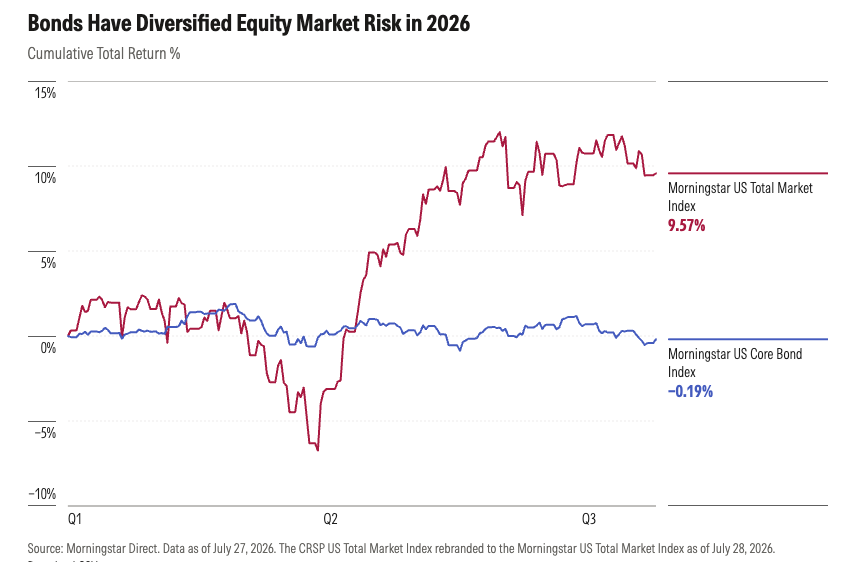
As you can see from the Morningstar US Core Bond Index’s slightly negative returns, 2026 has not been a stellar year for fixed income. Inflation is running hot. Interest rates are staying higher for longer.
But bonds have diversified equity market volatility. When the Morningstar US Total Market Index has declined this year—on artificial intelligence sentiment shifts or the Iran war—bonds have either gained or suffered far milder losses. They have earned their reputation as “ballast,” significantly reducing portfolio volatility.
Fascinatingly, we saw a similar pattern last year. The 2026 stock/bond performance graph above has a similar look to the 2025 one below. Of course, we had an even sharper equity market selloff early last year because of tariff turmoil, and bonds benefited from interest rate cuts and subdued inflation in 2025.
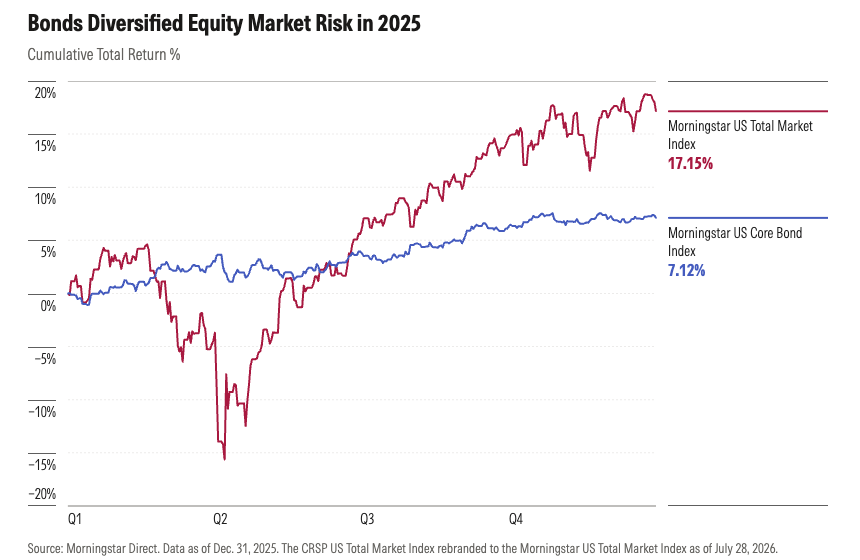
Performance in 2025 and 2026 has helped bonds recover from the reputational damage they incurred in 2022. Inflation and sharp rate hikes caused double-digit losses for both equities and fixed income that year. The “death of diversification” was declared.
Well, from the start of 2025 through the midpoint of 2026, the correlation coefficient between US stocks and US bonds (represented by the indexes used above) is just 0.11—barely positive. That compares with 0.66 in 2022. The lesson: correlations change. While bonds don’t always diversify equity market risk, they often do.
Global Equity Exposure Pays Off
Last week, I covered international stocks’ strong 2026. Their margin of outperformance was larger before the late-February onset of the Iran war sent energy prices spiking, but they are still ahead of US stocks so far this year.
International stocks also outperformed in 2025. Last year, they benefited from US dollar depreciation and a rally in European banks and defense. The net result is that US investors have profited from global exposure over the past 19 months.
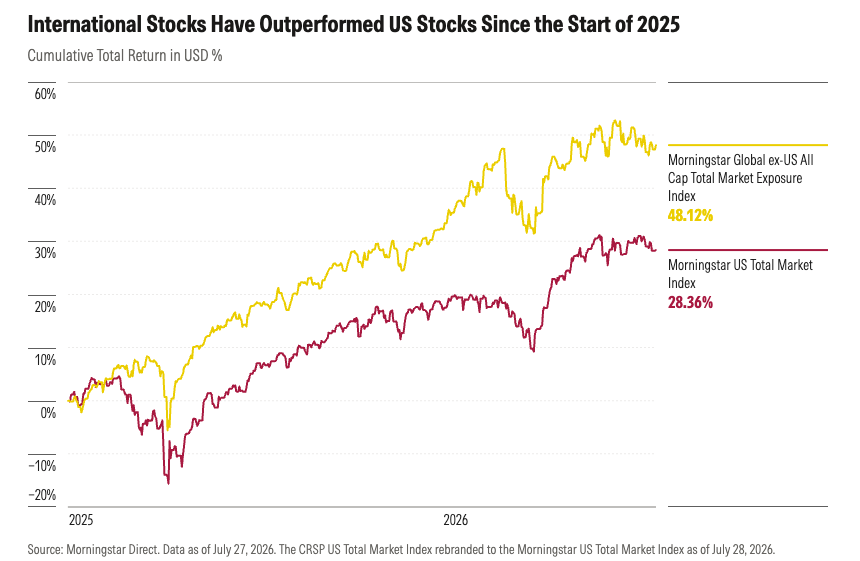
Cynical readers might reply that a broken clock is right twice per day. International stocks will need to outperform for many more years before they catch up to their US counterparts. For the 15 years between 2010 and 2024, the Morningstar Global ex-US All Cap Target Market Exposure Index rose by 122% in US dollar terms. Meanwhile, the US stock market appreciated by a factor of nearly 6. A long run of strength for the dollar explains only part of that performance disparity. The rise of the US “hyperscaler” stocks was a bigger factor.
Cynics might also point out that recent outperformance for international stocks has a lot to do with emerging-market semiconductor companies. The AI infrastructure buildout has delivered bumper earnings for Taiwan Semiconductor TSM and SK Hynix 00660, along with their US peers. They don’t provide much diversification benefit to investors heavy on US equities.
But the broad universe of ex-US equities looks very different from the US market. It’s far less top-heavy and is more diversified by economic sector. Whereas technology stocks represent 36% of the US market, financial services is the largest sector internationally at just 22%.
As I wrote last week, geographic leadership has historically gone in cycles. International stocks led in the 1970s, much of the 1980s, and the first decade of the 2000s. There are lots of great companies and growth trends across the globe. International investing, therefore, can be seen as broadening the opportunity set.
Small Caps Came Back
US small-cap stocks have lagged for years. The last calendar year in which they meaningfully outperformed their larger counterparts was 2016. They have fallen short even in conditions considered to be favorable, like amid strong economic growth and falling interest rates.
But things are looking up in 2026. “Small-cap stocks are having a moment—a pretty big moment,” wrote my colleague Susan Dziubinski. For most of 2026, investors with US small-cap stock exposure have enjoyed higher returns than those invested just at the market’s higher end.
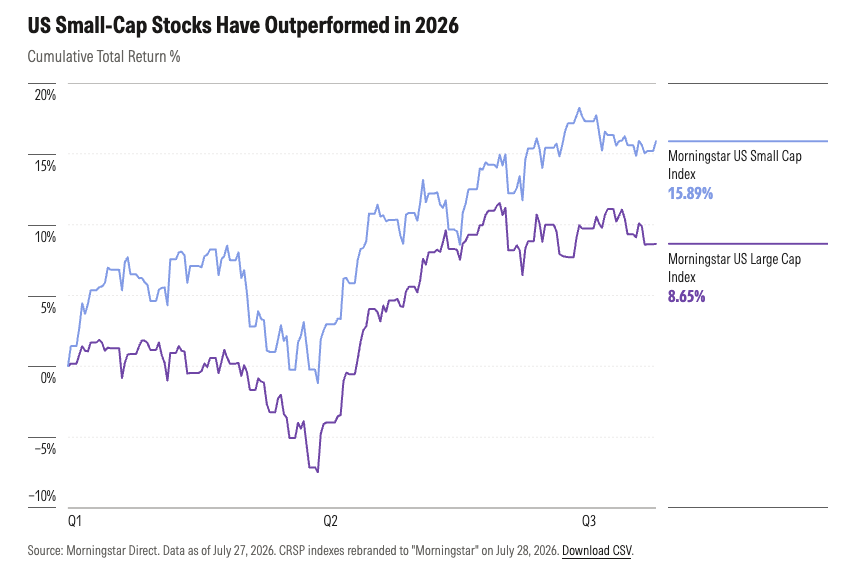
What accounts for the small-cap rally? It’s not like the economy is red-hot, and it certainly can’t be attributed to falling interest rates. When I run attribution analysis on the Morningstar US Small Cap Index for 2026, some smaller AI stocks like Sandisk SNDK and Bloom Energy #BE show up as big contributors, as do healthcare names like Revolution Medicines RVMD.
Similar to international stocks, US small caps as a group look very different from their larger cousins. They are far less top-heavy and tech-heavy. Small caps are a sprawling and diffuse universe with industrials as the largest sector grouping. They are also relatively cheap on a price/earnings basis. It’s a volatile asset class, but one with diversification potential.
Other Niche Diversifiers Have Also Added Value
Looking across our index range, I see the Morningstar MLP Composite Index of midstream energy stocks with superb returns this year. Rising energy prices resulting from the Iran war have helped. It’s a good reminder that natural resources-related investments often rise during inflationary periods. They were practically the only bright spot in 2022, when stocks and bonds both sank.
Elsewhere, the Morningstar US REIT Index is having a strong 2026. That’s good to see because real estate-related stocks have lagged for years. Data center buildouts are part of the story there.
Meanwhile, my colleague David Reyna wrote about a tough stretch for alternative investment strategies. Other colleagues have pointed out that private equity and private credit don’t necessarily offer significant diversification benefits. A few key asset classes go a long way. In the words of my colleague Amy Arnott, when it comes to diversification, “more isn’t always better.”
©2026 Morningstar. All Rights Reserved. The information, data, analyses and opinions contained herein (1) include the proprietary information of Morningstar, (2) may not be copied or redistributed, (3) do not constitute investment advice offered by Morningstar, (4) are provided solely for informational purposes and therefore are not an offer to buy or sell a security, and (5) are not warranted to be correct, complete or accurate. Morningstar has not given its consent to be deemed an "expert" under the federal Securities Act of 1933. Except as otherwise required by law, Morningstar is not responsible for any trading decisions, damages or other losses resulting from, or related to, this information, data, analyses or opinions or their use. References to specific securities or other investment options should not be considered an offer (as defined by the Securities and Exchange Act) to purchase or sell that specific investment. Past performance does not guarantee future results. Before making any investment decision, consider if the investment is suitable for you by referencing your own financial position, investment objectives, and risk profile. Always consult with your financial advisor before investing.
Indexes are unmanaged and not available for direct investment.
Morningstar indexes are created and maintained by Morningstar, Inc. Morningstar® is a registered trademark of Morningstar, Inc.