

Lost in a torrent of news about Nvidia NVDA this year—its role in financing $500 billion in artificial intelligence investments, its forecasts of 70% year-on-year revenue growth, and its acquisition of Hugging Face—was a dividend announcement. In May, Nvidia told shareholders that it would increase its quarterly payout to $0.25 per share from $0.01 per share. That’s a 2,400% increase, according to my calculations!
Analysts will be quick to point out that perspective is key. “Nvidia’s dividend is virtually immaterial relative to its financial health and forward prospects,” wrote Brian Colello, who covers semiconductor stocks for Morningstar. Nvidia’s dividend yield will continue to register well below 1%. And even more of the company’s cash is being spent buying back shares.
But in absolute terms, Nvidia’s dividend is huge. Something like $25 billion per year will be returned to shareholders. That sum will make Nvidia one of the largest dividend payers in the US stock market.
The Nvidia news also comes at a time when the Morningstar US Dividend Growth Index is neck and neck with the broad US stock market, which is unusual in an up year. So, what’s going on with dividend growth stocks this year? And what does Nvidia’s dividend hike suggest, if anything?
Is Nvidia a True Dividend Growth Stock?
Despite the dividend increase, it’s probably too soon to call Nvidia a dividend growth stock. Although the company initiated a quarterly dividend back in 2013, the payout was paltry until the 2026 increase. The Morningstar US Dividend Growth Index requires five consecutive years of dividend growth. Other dividend indexes on the market require an even longer history. Active managers running dividend growth strategies interpret their mandates in different ways.
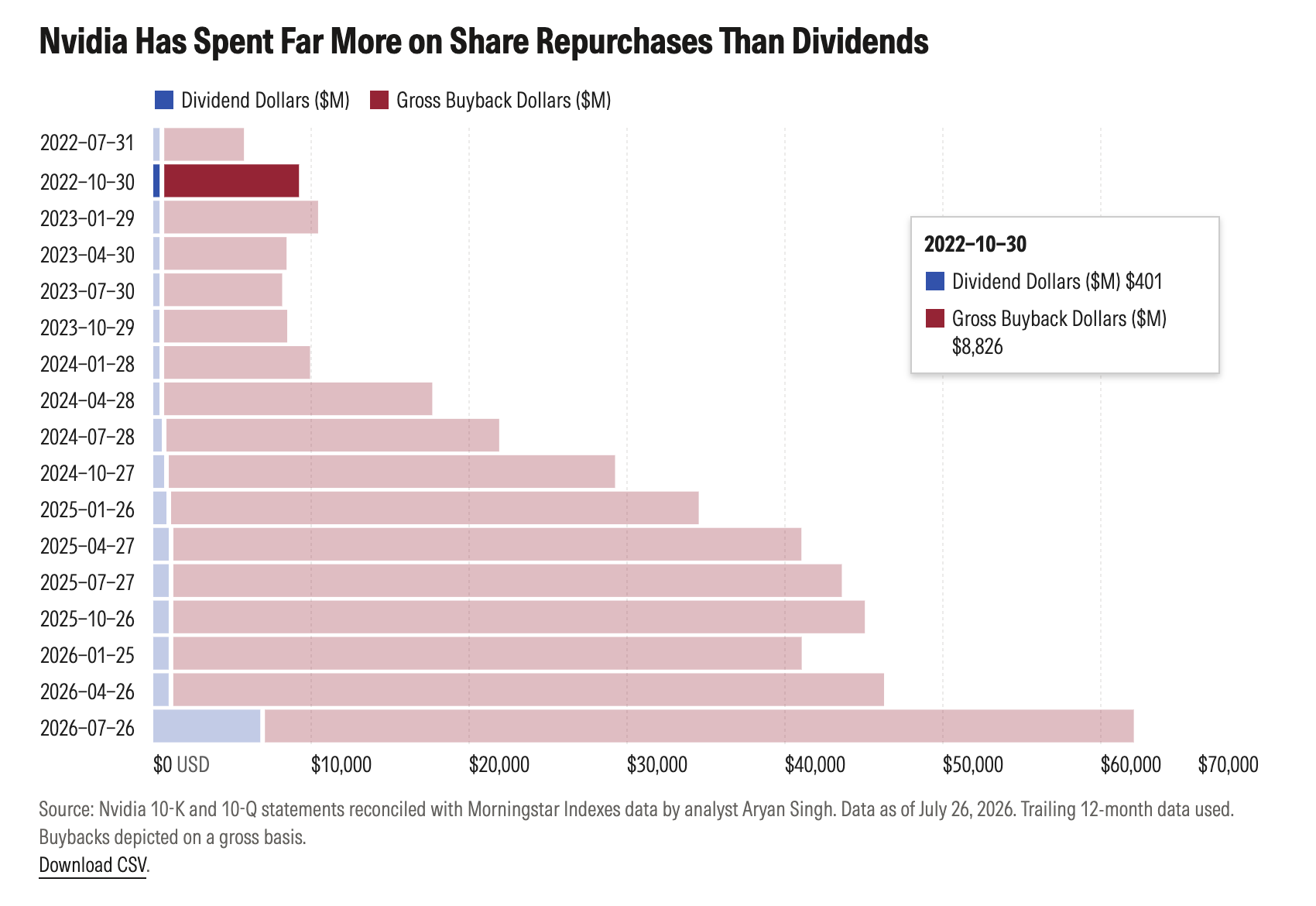
“Most of Nvidia’s distributions to shareholders come in the form of share repurchases,” writes Colello. That’s consistent with the overall US stock market trend. As I wrote about recently, companies have spent far more buying back their own shares than they have on dividends.
Indeed, Nvidia announced an $80 billion share buyback program at the time of its dividend declaration. The company’s preference when it comes to cash allocations is clear in the exhibit below.
What’s the Big Deal About Dividend Growth Anyway?
Dividend growth has long been viewed as a symbol of corporate “quality.” Only profitable companies secure in their financial positions consistently increase cash returned to shareholders. While share buybacks can be opportunistic, dividends are a commitment. The market typically punishes dividend cutters.
The nearly 400 stocks in the Morningstar US Dividend Growth Index include a mix of market leaders and less familiar names. Mega-caps like Microsoft MSFT, JPMorgan Chase JPM, Johnson & Johnson JNJ, and ExxonMobil XOM, which sit atop the index because constituents are weighted by market capitalization, are joined by mid- and small-cap stocks like Becton Dickinson BDX, DTE Energy DTE, and American Financial Group AFG.
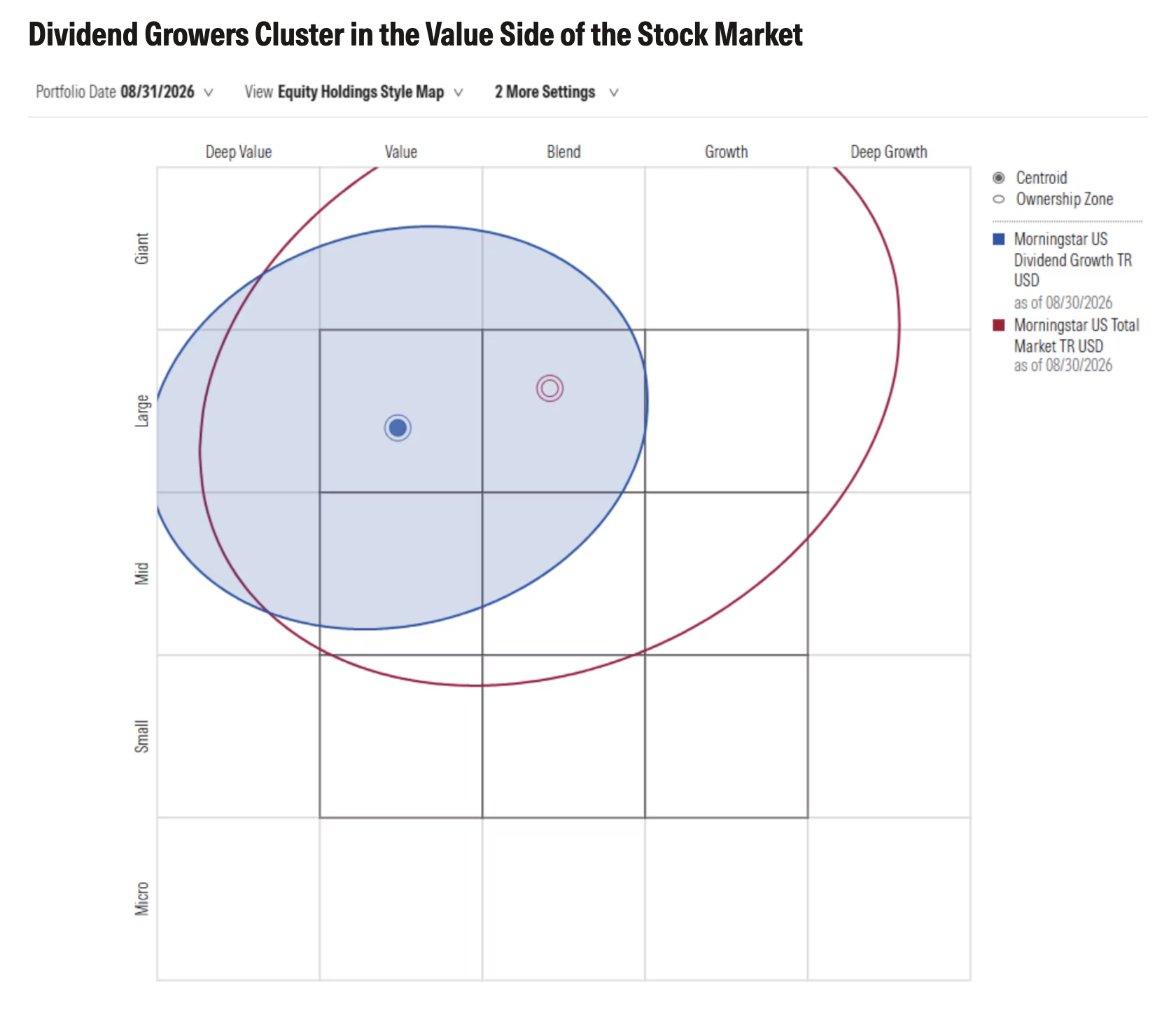
Investment style-wise, the dividend growth index leans toward value. Technology stocks, which tend to carry higher-than-average multiples, represent just 17.6% of index weight. That’s less than half their share of the broad US stock market. Meanwhile, the generally lower-priced financial services, healthcare, industrials, and consumer defensive sectors are overrepresented among dividend growers.
What about performance? Dividend growers have a reputation for being defensive stocks. Strong balance sheets and moderate price tags mean that dividend growers often shine during risk-off market environments.
Indeed, the Morningstar US Dividend Growth Index has generally outperformed during selloffs. It declined by less than the broad US stock market in down years 2018 and 2022. It also held its value relatively well during the tariff turmoil of March-April 2025 and in negative months like March and June 2026. From a volatility perspective, the dividend growth index has registered a standard deviation of returns well below the market.
Why Are Dividend Growth Stocks Performing Well in 2026?
Given its defensive profile, it’s somewhat surprising that the dividend growth index is performing well in 2026. After all, the market is up double digits as the fourth quarter approaches. The technology sector has led this year, powered by the AI buildout. Those conditions aren’t typically favorable to dividend growers.
The energy sector helps explain dividend growth’s strong returns. With the conflict in the Middle East pushing up oil prices, energy companies are booking huge profits. Key index constituents include ExxonMobil, with a near four-decade-long history of dividend growth, and ConocoPhillips COP, which rebuilt its dividend growth track record after low oil prices forced a dividend cut in 2016.
But the biggest contributor to 2026 performance—both in absolute and relative terms—is the healthcare sector. Johnson & Johnson, Merck MRK, and UnitedHealth UNH are all having stellar years. J&J is a paragon of dividend growth going back to the 1960s. Merck and UnitedHealth have more modest histories in the neighborhood of 15 years, but UnitedHealth has posted double-digit dividend growth rates.
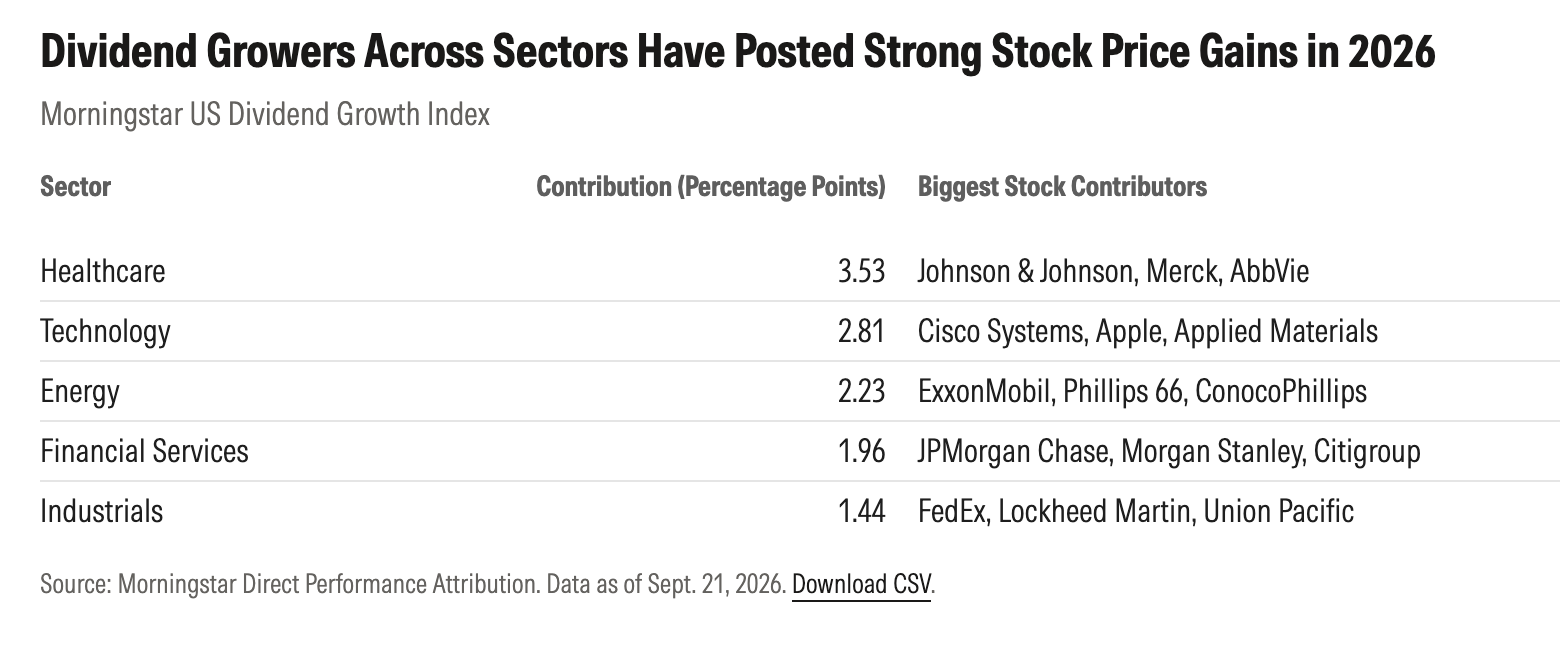
The strong year for dividend growth reflects a number of trends. First, market leadership broadened from the narrow group of Magnificent Seven companies that dominated 2023-25. Nvidia, for example, has performed well, but not at the same level as in recent years. Amazon.com AMZN, Alphabet GOOGL, and Meta Platforms META have lagged. Second, this has been a year in which value stocks have outperformed growth. That includes the energy and healthcare sectors, but also value technology stocks benefiting from investments. Third, it has generally been a strong year for companies returning cash to shareholders, as I wrote about recently.
Actually, this isn’t the first time dividend growers have outperformed in an up market. The dividend growth index also posted stellar returns in 2021, another year of market “breadth.” All US sectors posted strong returns then, and little separated growth and value stocks.
What Does Nvidia Joining the Dividend Growth Party Mean?
Some might see Nvidia’s dividend hike as a sign the company is entering a new, more slow-growth life stage. That doesn’t fit with the 70% revenue growth forecast. One thing that’s certain is that Nvidia’s cash pile is massive.
Nvidia is also part of a trend I’ve written about regarding tech and tech-adjacent companies paying more dividends. Microsoft and Apple AAPL have both been constituents of the dividend growth index for years. In 2024, Meta and Alphabet both initiated payouts to shareholders.
Nvidia also fits the dividend growth profile when it comes to profitability and financial strength. Increasing a payout can be seen as a sign of corporate quality. Because of their defensive characteristics, dividend growers are a good option for investors concerned about a market bubble.
Also published on Morningstar.com
©2026 Morningstar. All Rights Reserved. The information, data, analyses and opinions contained herein (1) include the proprietary information of Morningstar, (2) may not be copied or redistributed, (3) do not constitute investment advice offered by Morningstar, (4) are provided solely for informational purposes and therefore are not an offer to buy or sell a security, and (5) are not warranted to be correct, complete or accurate. Morningstar has not given its consent to be deemed an "expert" under the federal Securities Act of 1933. Except as otherwise required by law, Morningstar is not responsible for any trading decisions, damages or other losses resulting from, or related to, this information, data, analyses or opinions or their use. References to specific securities or other investment options should not be considered an offer (as defined by the Securities and Exchange Act) to purchase or sell that specific investment. Past performance does not guarantee future results. Before making any investment decision, consider if the investment is suitable for you by referencing your own financial position, investment objectives, and risk profile. Always consult with your financial advisor before investing.
Indexes are unmanaged and not available for direct investment.
Morningstar indexes are created and maintained by Morningstar, Inc. Morningstar® is a registered trademark of Morningstar, Inc.