

Another well-known company is cutting its dividend. In mid-July, Conagra Brands CAG told shareholders it would reduce its quarterly payout by half. If you don’t know Conagra, a packaged foods company, you probably recognize the names on its products—Slim Jim, Duncan Hines, Reddi-wip, and Orville Redenbacher’s among them.
Conagra joins a long line of name-brand dividend cutters. Last year, we wrote about a 50% cut from Dow Chemical DOW, a company with 19th-century origins. Walgreens, 3M MMM, Intel INTC, and Harley-Davidson HOG all disappointed shareholders by reducing, suspending, or eliminating dividends in recent years. Their stock prices generally fell on the news.
How can investors identify companies with dividends that may be at risk? One popular approach is to look at history. But many of the companies listed above had impressive track records of dividend payments and even dividend growth at the time of their cuts.
Morningstar equity income indexes employ a few forward-looking screens for dividend durability. None are foolproof. But the screens tilt the odds in investors’ favor. Below, I’ll cover some ways we identify at-risk dividends, then name companies that may follow Conagra in announcing a cut.
High Yield Can Mean High Risk
Conagra is what’s known as a “yield trap.” At the end of June 2026, the stock yielded north of 10% on a trailing 12-month basis. That kind of payout can seriously tempt income investors.
But high yields also signal risk. Yield rises when share price falls, and Conagra’s stock has done a lot of falling lately. In fact, it declined by more than 50% over the three years through the end of June, while the Morningstar US Total Market Index rose 75% over that time.
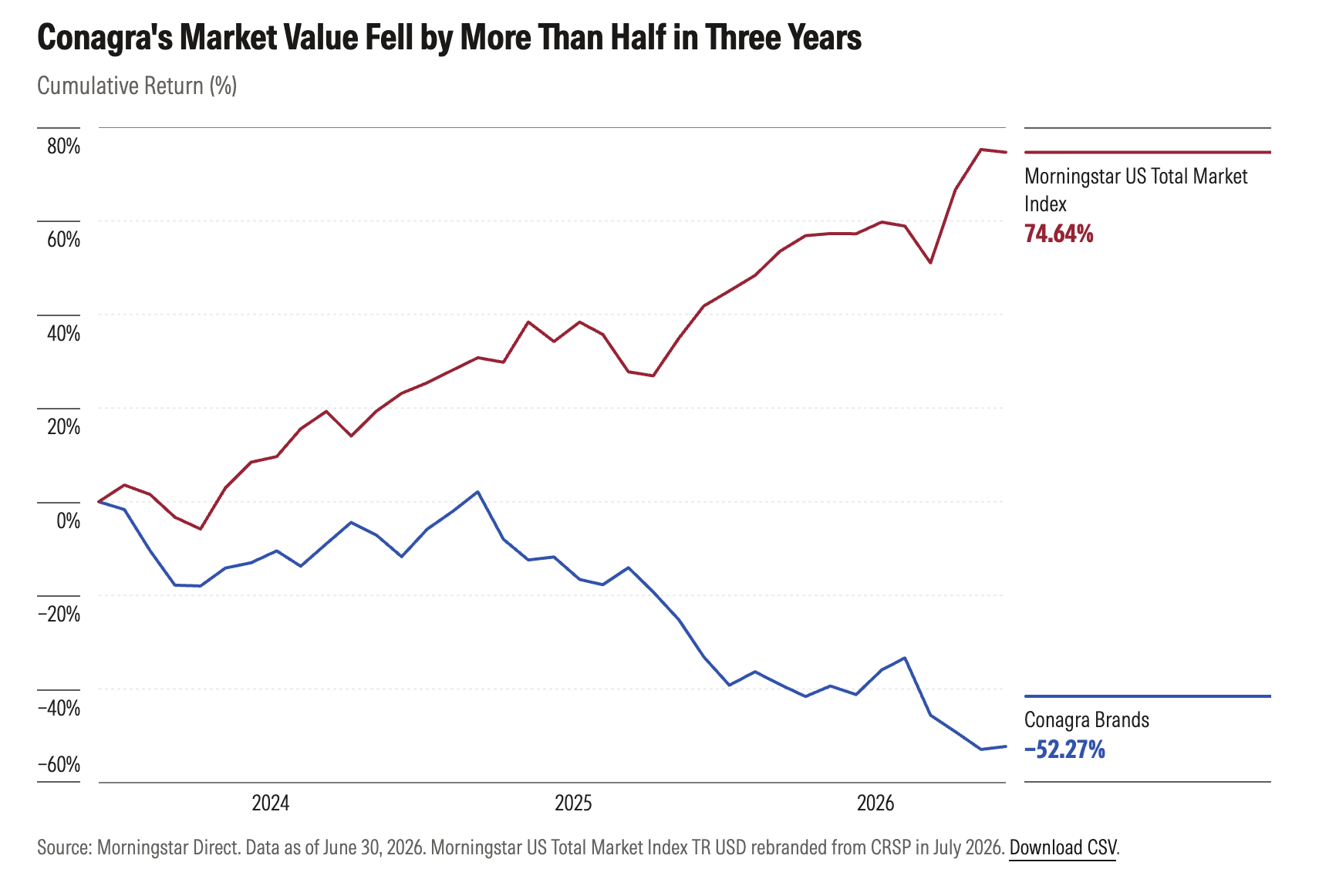
What accounts for the stock’s decline? Morningstar’s Equity Research Team does not cover Conagra—but analysts have mentioned several factors weighing on the packaged food industry, including inflation, competition from organics, appetite suppression from weight-loss drugs, and more. Here’s what happened to Conagra’s yield as its $1.40 dividend per share was divided by an ever-shrinking denominator.
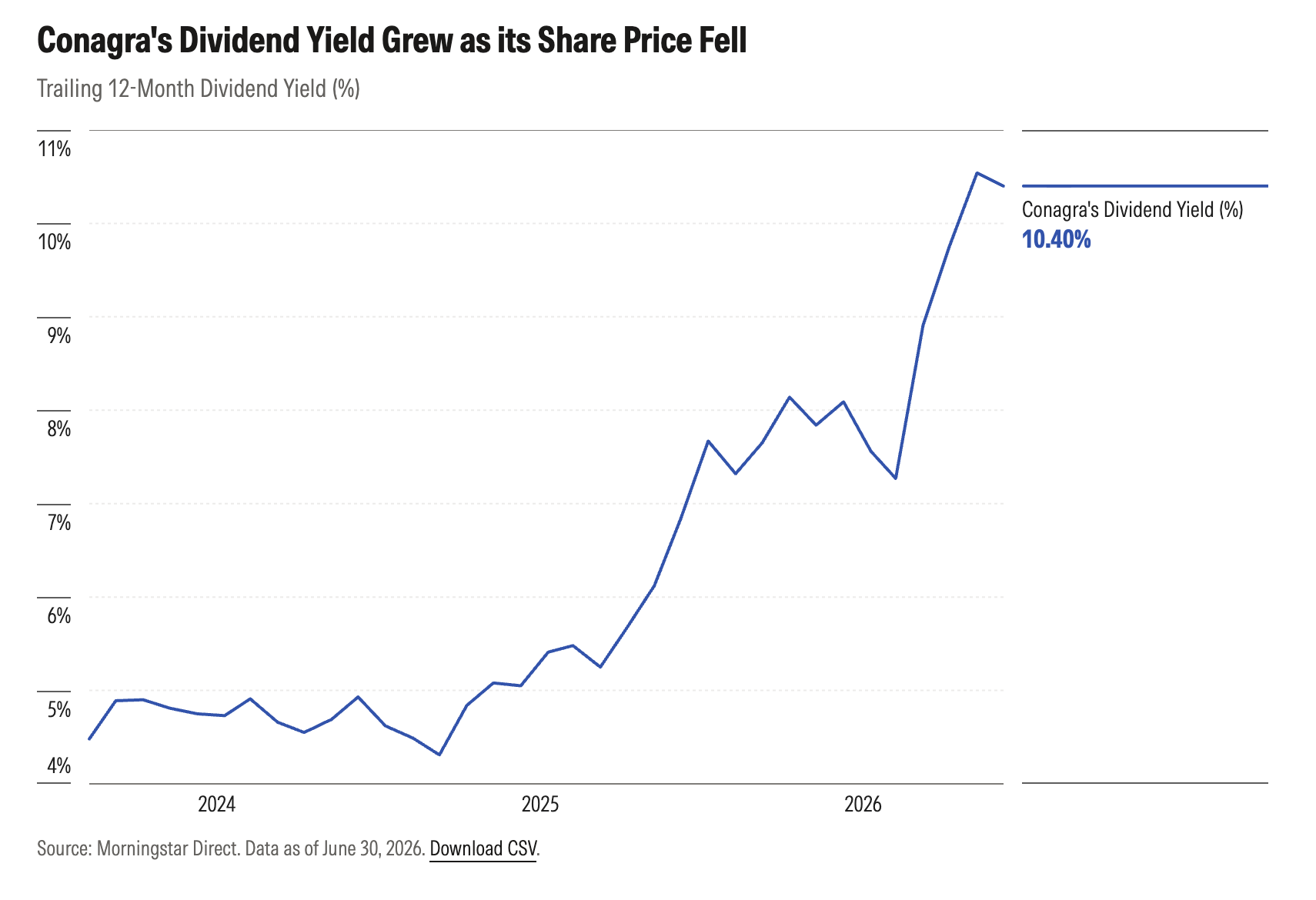
A crude way to avoid troubled companies and industries is to simply screen out the highest yielders. In the case of one Morningstar dividend index, stocks in the top 10% of the universe by dividend yield are ineligible for inclusion.
Screening for Dividend Durability: Dividend Coverage, Financial Health, and Quality
While excluding the highest yielders is a blunt instrument, we have more precision screens for dividend durability in our toolkit. Earlier this year, I wrote about three such screens. My colleague Saumya Gattani, a quantitative researcher on Morningstar Indexes, showed that over the past 20 years, each has helped identify at-risk dividends.
First is the payout ratio, which measures the degree to which the dividend is covered by a company’s earnings. If the ratio is too high, the dividend may be unsustainable. Morningstar dividend stock indexes screen out companies with payout ratios above 100%.
Another dividend screen we employ, distance to default, is a gauge of financial health. It measures the risk that the value of a company’s assets will fall below the sum of its liabilities. Distance to default considers equity value and share-price volatility on the theory that the market can sniff out weakness before it shows up in balance-sheet numbers. Companies are compared with sector peers, and the bottom half of the universe is ineligible for dividend indexes.
Finally, we use the Morningstar Economic Moat Rating as a dividend screen. Assigned by our equity research team, moats signify a durable competitive advantage. Moats protect profits from competition. Since profits fund dividends, some of our dividend indexes exclude no-moat-rated companies. The trick is that not every dividend stock is covered by Morningstar analysts.
Whose Dividends Are Most at Risk?
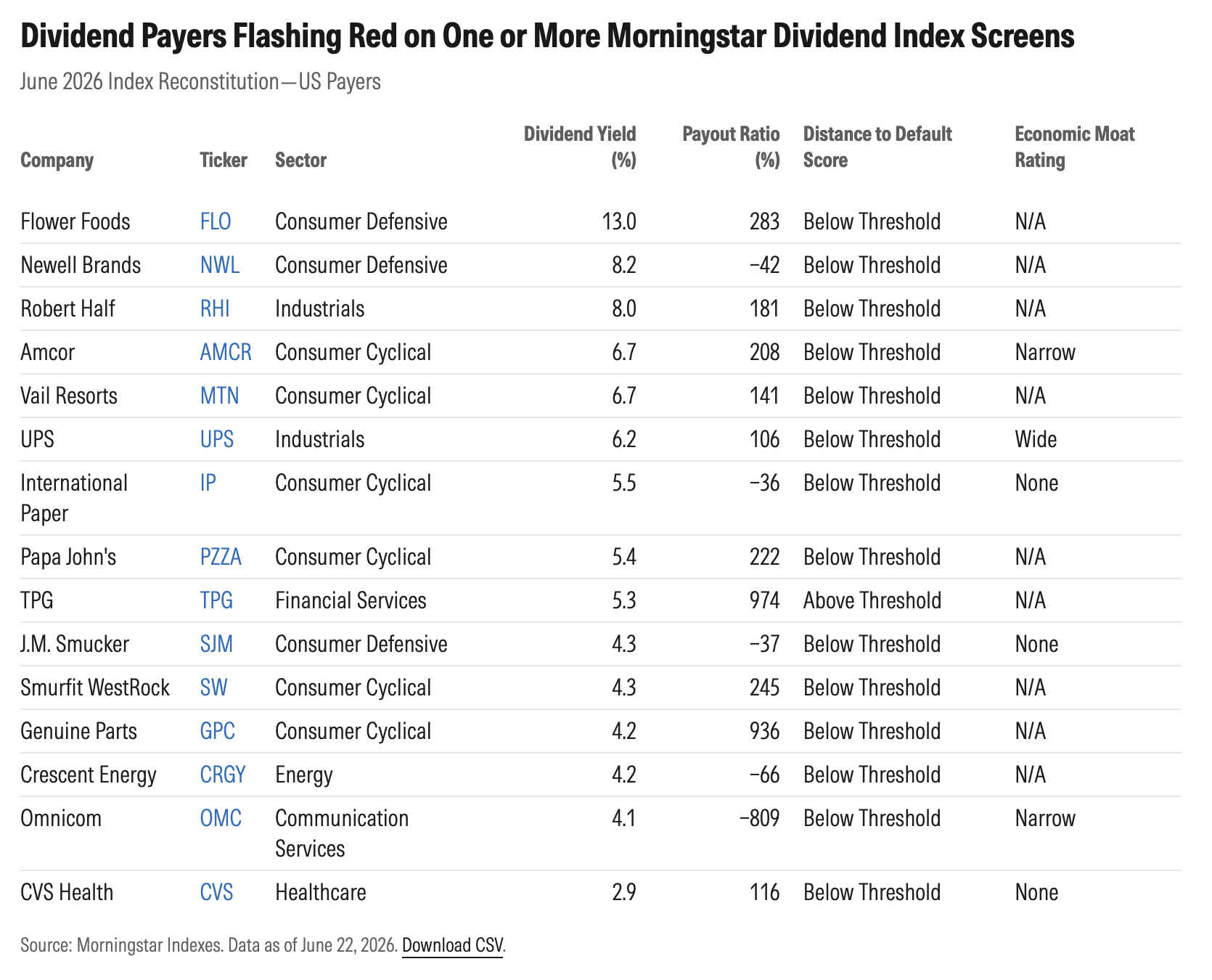
Saumya compiled a list of companies excluded from Morningstar dividend indexes at our June reconstitution. Here’s a sampling of stocks from that group that might attract income investors with their impressive yields, but that flash red on one or more indicators—payout ratios above 100% (or even negative as a result of negative earnings), distance to default scores in the bottom half of their sectors, or no-moat ratings.
Successful Dividend Investing Considers Both Income and Total Return
I’ve said it before, and I’ll say it again: The stock market’s juiciest yields are often illusory. Pursuing income without regard to dividend durability can lead to bad outcomes. When a dividend is cut, investors typically experience a decline in both income and principal.
Conagra is the latest cautionary tale for dividend investors. High yield can mean high risk. When investing in dividend payers, it’s crucial to diversify and be mindful of yield traps.
©2026 Morningstar. All Rights Reserved. The information, data, analyses and opinions contained herein (1) include the proprietary information of Morningstar, (2) may not be copied or redistributed, (3) do not constitute investment advice offered by Morningstar, (4) are provided solely for informational purposes and therefore are not an offer to buy or sell a security, and (5) are not warranted to be correct, complete or accurate. Morningstar has not given its consent to be deemed an "expert" under the federal Securities Act of 1933. Except as otherwise required by law, Morningstar is not responsible for any trading decisions, damages or other losses resulting from, or related to, this information, data, analyses or opinions or their use. References to specific securities or other investment options should not be considered an offer (as defined by the Securities and Exchange Act) to purchase or sell that specific investment. Past performance does not guarantee future results. Before making any investment decision, consider if the investment is suitable for you by referencing your own financial position, investment objectives, and risk profile. Always consult with your financial advisor before investing.
Indexes are unmanaged and not available for direct investment.
Morningstar indexes are created and maintained by Morningstar, Inc. Morningstar® is a registered trademark of Morningstar, Inc.