

Only a few of Morningstar’s market benchmarks are in negative territory so far this year, but our listed private equity index is one of them. Publicly traded companies focused on private markets investing—Blackstone BX, KKR KKR, and Apollo Global Management APO being the largest—are one of the weakest pockets of global equity markets in 2026.
What’s curious is that Morningstar PitchBook indexes that track private companies as well as those that measure the performance of “semiliquid funds” holding private assets have posted gains in 2026. At the extreme end, an index of generative artificial intelligence businesses that includes Anthropic and OpenAI is up triple digits for the year to date.
Private markets managers will point to this disconnect as a sign that they’ve been victims of fearmongering. Skeptics will counter that valuations on private assets are unrealistic. The truth, as if often the case, may lie somewhere in between.
2026: A Tough Year for Private Market Managers
Not only have private market managers underperformed the overall equity market so far in 2026, but they also lag the Morningstar industry index of publicly traded asset managers. It has been a rough year for stocks like Blackstone and Apollo. Partners Group PGHN of Switzerland has seen a share price decline of 22%.
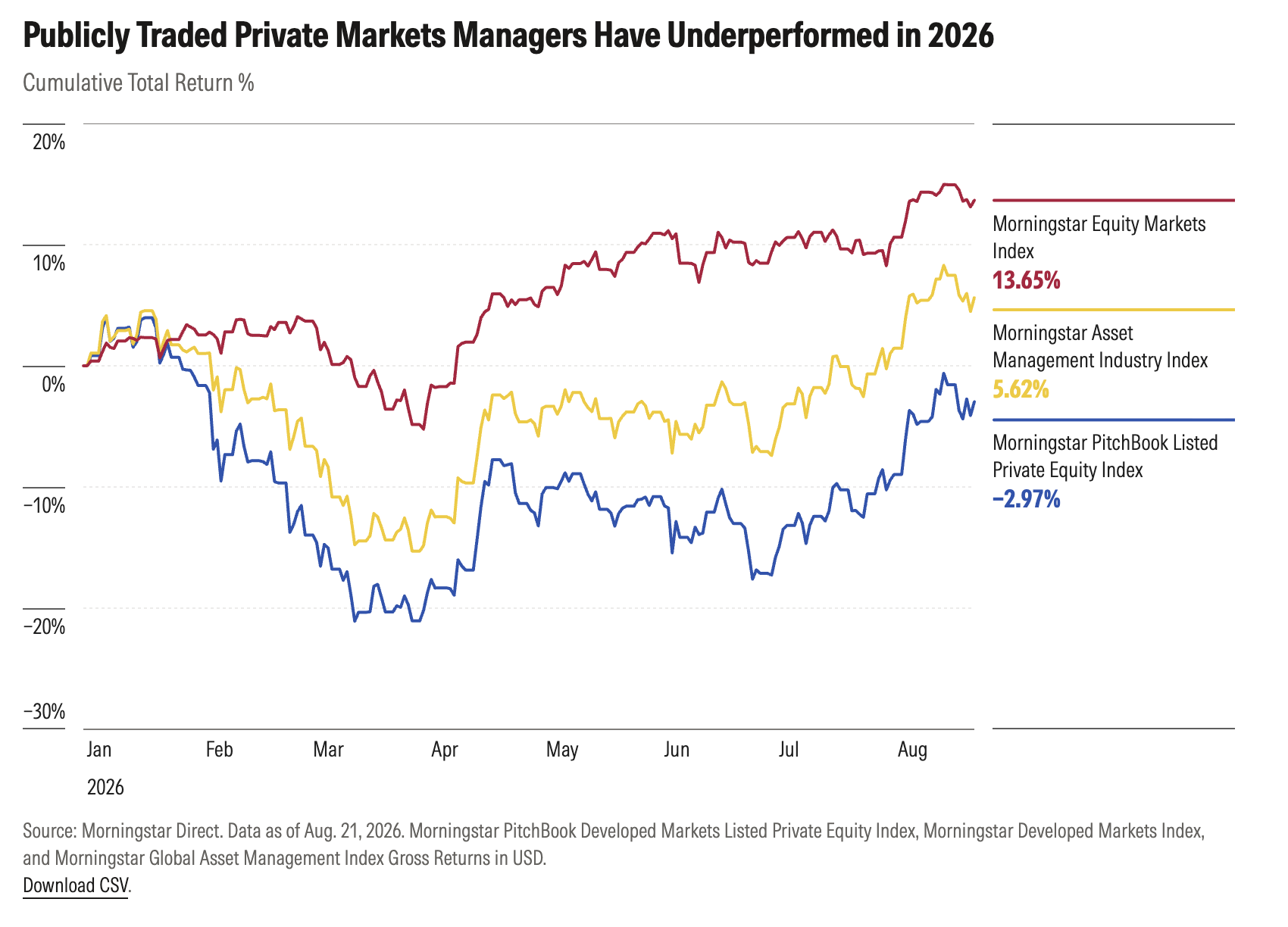
The initial trigger for these losses came early in 2026. “An aggressive selloff in public software stocks, driven by fears of artificial intelligence displacement, spilled over into private credit, which includes loans to many of those same software companies,” wrote Morningstar researchers. Investors responded by exiting semiliquid funds. (I should say that they exited those funds to the extent that exiting is allowed).
Many readers will be familiar with the case of Blue Owl Capital OWL, a constituent of the listed private equity index that halted redemptions from one of its funds in February. Its share price has been hit hard, down nearly 20% for 2026. The company “has been among the core group of alternative investment strategy managers trying to turn private credit from an investment for big institutions into one easily accessible by millions of wealthy individuals,” according to Alexander Davis of PitchBook.
It should be noted that Morningstar’s listed private equity index has rebounded somewhat from losses early in the year. Earnings for Blackstone and others have been “solid” in the assessment of Greggory Warren, who covers alternative asset managers for Morningstar equity research. In a July call with shareholders, Blackstone CEO Jon Gray said the firm was seeing decreasing redemption demand from its funds, which he attributed to a lower “level of noise” from the media.
Yet a Decent Year for Private Market Performance
Gray went on to talk about fears of a “massive calamity” that “did not occur.” That’s supported by the 2026 performance for the Morningstar PitchBook US Evergreen Fund Index, which measures semiliquid vehicles that invest in all manner of unlisted assets, including private equity, private debt, direct lending, and more. The carve-outs from that master index have posted positive if unspectacular gains for the year to date.
On the spectacular side are returns for private companies involved in AI. The Morningstar PitchBook GenAI 20 Index, which includes the likes of Anthropic, OpenAI, and Databricks, is up triple digits so far this year. The index relies on pricing from companies’ latest round of funding. Private market investors have been assigning ever higher valuations to “frontier AI labs” and other late-stage, venture capital-backed AI businesses.
Skeptics will see that triple-digit gain as a sign of an AI bubble. SpaceX’s SPCX volatile ride since its June IPO has raised questions about valuations in AI-related businesses. Meanwhile, evergreen fund performance is challenged by the fact that the assets in their portfolios aren’t regularly marked to market. Some charge private market managers of engaging in “volatility laundering.”
Private Markets Face Real Challenges—Short-Term and Long-Term
It’s undeniable that private market managers face real challenges. “Private credit is grinding through a rough patch in the cycle,” wrote Marina Lukatsky of PitchBook. According to her team’s analysis, nearly 11% of the 5,000 private companies held by business development companies are facing some signs of credit pressure. The software industry, perceived to be at risk of major AI disruption, is the biggest problem area.
Credit issues are also apparent in the syndicated bank loan market, which is often used as a more liquid proxy for private credit. While the Morningstar LSTA US Leveraged Loan Index is in positive territory for the year to date, a carve-out that contains only loans to software companies has declined by 3% since the start of 2026. Software & Services represent nearly 15% of the overall bank loan market.
Interest rates remain a headwind for private market activity. Higher-for-longer borrowing costs have had a disproportionate impact on private market managers, for whom leverage is a key tool. Rock-bottom pandemic-era rates were behind a blockbuster 2021, when private market dealmaking set records, and rising rates were blamed for a wretched 2022.
While rates are changeable, there’s a risk that the events of 2026 will undermine private markets managers’ long-term efforts to tap into the wealth channel. In an analysis of Blackstone, Greggory Warren wrote:
[W]e believe the negative perception currently attached to the private credit market, brought on by peer Blue Owl’s handling of some of its private credit funds, has raised concerns about liquidity for these types of funds, especially given the riskiness of their direct lending portfolios. This is likely to drag on results in the near to medium term.
Greggory Warren
Jack Shannon, a Morningstar researcher who covers semiliquid funds, wrote recently that the “liquidity crunch was inevitable.” He notes that widely accessible mutual funds are often subject to acute redemption requests from investors, especially in aggressive and/or high-yielding categories. He notes that semiliquid funds, particularly in private credit, have seen asset growth of more than 2,000% in the past five years. This type of extreme inflow is prone to reversing. “If these funds follow the typical pattern of high-inflow mutual funds and ETFs, expect a surge of redemption requests in the coming years,” Shannon writes.
Private markets managers are now talking about model portfolios as a route to retail investors. The idea is to shift standard asset allocations from a 60/40 stock/bond split to 50/30/20, with 20% going to private markets. Less-liquid investments, the thinking goes, would be better used in the context of a long-term-focused, diversified portfolio.
Public/Private Convergence
Regardless of current challenges, the rise of private markets is a secular trend. A significant share of capital formation now takes place outside of public stock and bond markets, which has implications for traditional asset classes. The trillions allocated to private equity and private credit funds will be with us for years to come.
Still, the negative sentiment toward private market managers reflects legitimate concerns. Only time will tell if private credit stresses will metastasize. It’s also hard to know if the case of Blue Owl and other semiliquid funds will dent efforts to bring private assets to the masses—and whether the masses will decide to invest. In the words of Morningstar Research pioneer Don Phillips:
[P]rivate credit doesn’t understand retail investors. Retail investors, if you look at managed investment products over the last hundred years, you move from unit investment trust to closed-end funds to open-end funds to index funds to ETFs, the whole move, every move has given investors either greater diversification, lower cost, or more liquidity. And now all of a sudden you look at private assets, they move against all three of those trends. They’re going to be higher costs, they’re going to have less liquidity, and they’re going to be more concentrated.
Don Phillips
©2026 Morningstar. All Rights Reserved. The information, data, analyses and opinions contained herein (1) include the proprietary information of Morningstar, (2) may not be copied or redistributed, (3) do not constitute investment advice offered by Morningstar, (4) are provided solely for informational purposes and therefore are not an offer to buy or sell a security, and (5) are not warranted to be correct, complete or accurate. Morningstar has not given its consent to be deemed an "expert" under the federal Securities Act of 1933. Except as otherwise required by law, Morningstar is not responsible for any trading decisions, damages or other losses resulting from, or related to, this information, data, analyses or opinions or their use. References to specific securities or other investment options should not be considered an offer (as defined by the Securities and Exchange Act) to purchase or sell that specific investment. Past performance does not guarantee future results. Before making any investment decision, consider if the investment is suitable for you by referencing your own financial position, investment objectives, and risk profile. Always consult with your financial advisor before investing.
Indexes are unmanaged and not available for direct investment.
Morningstar indexes are created and maintained by Morningstar, Inc. Morningstar® is a registered trademark of Morningstar, Inc.