

To paraphrase Lizzo, it’s about time! After struggling for years, real estate investment trusts are well ahead of the broad US stock market for the first seven months of 2026. If the Morningstar US REIT Index can maintain its edge, this will be its first calendar year of outperformance since 2021.
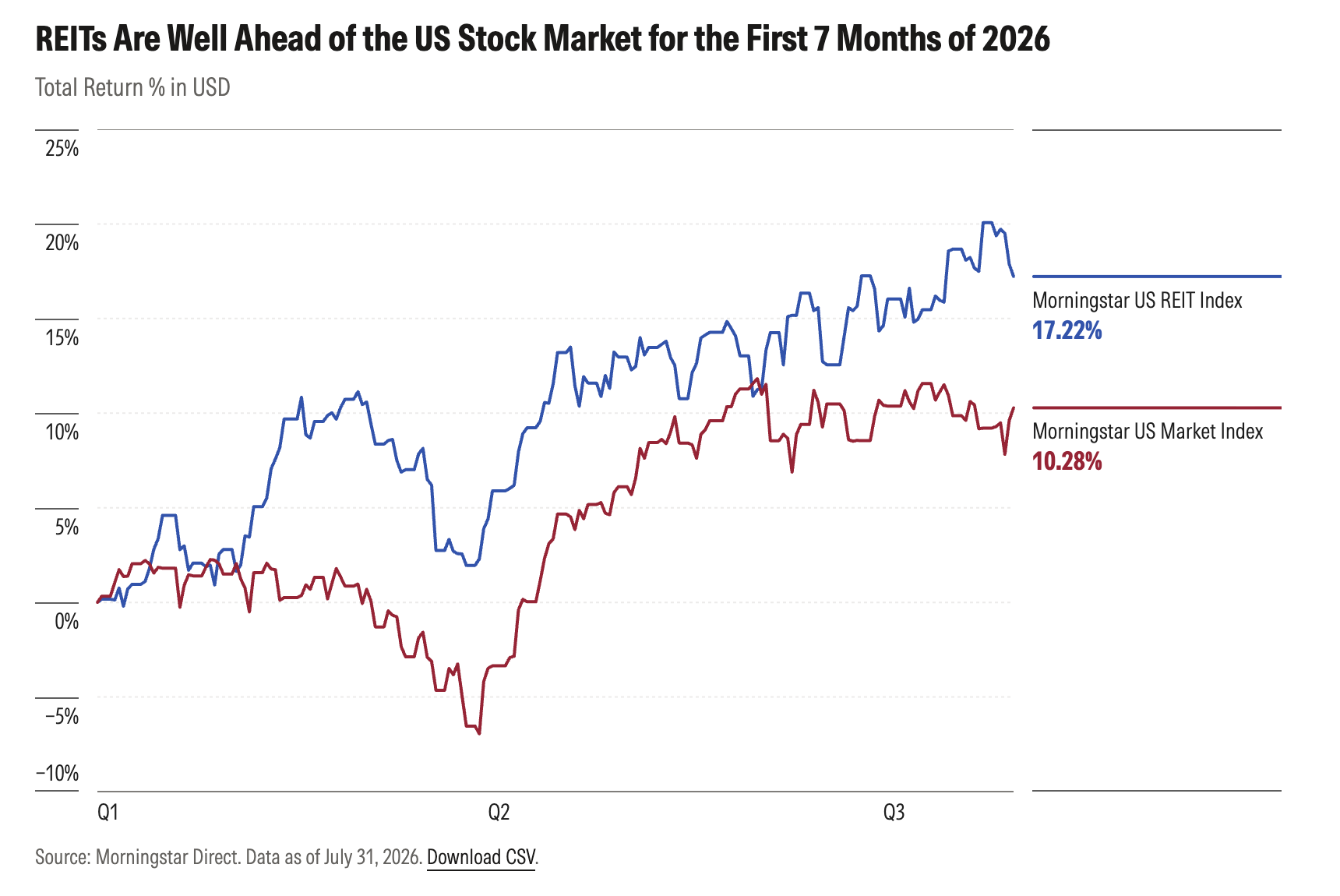
Last June, I wrote Why Stock Investors Should Take a Closer Look at REITs. I talked about the headwinds they face, including high interest rates and elevated inflation. But I also highlighted their compelling valuations. Then, I spent the second half of 2025 feeling silly, as REITs’ struggles continued.
Well, I’m still far from gloating. Despite their strong 2026, REITs still trail the market over the past 12 months. The good news is, there may be more upside potential for this oft-overlooked asset class.
What’s Behind the 2026 REIT Turnaround?
If you suspect that artificial intelligence data centers have something to do with REITs’ 2026 outperformance, you’d be right—but only partially. Equinix EQIX, which Morningstar analyst Martin Szumski describes as “the largest third-party data center operator in the world by revenue,” is one of the best-performing REITs in 2026. Prologis PLD, another 2026 star, can thank data center development for some of its strong recent results as well.
But there are other dimensions to the 2026 REIT performance story. The largest REIT in the US market as of mid-2026, Welltower WELL, focuses on senior housing. It enjoys demographic tailwinds, specifically demand from the aging baby boom generation. But it’s also well-positioned to benefit from the Affordable Care Act given its cost and quality advantages. Welltower’s share price gained more than 30% for the first seven months of the year.
Simon Property Group SPG is another big 2026 winner. The mall operator recently posted its highest rent growth in a decade. Simon’s high-end retail properties have recovered from the pandemic-driven downturn in brick-and-mortar shopping.
Kevin Brown, who analyzes REITs for Morningstar’s equity research team, has noted the close connection between REIT performance and interest rates. Back in 2022, he predicted that higher interest rates would weigh on REIT returns. That proved prescient.
As bond yields shot up, income investors found themselves with better options than REITs. Not only that, but higher borrowing costs slowed activity in the space, dampening mergers and acquisitions. The first point is evident when comparing the yield on the Morningstar US REIT Index with that of the Morningstar US Core Bond Index.
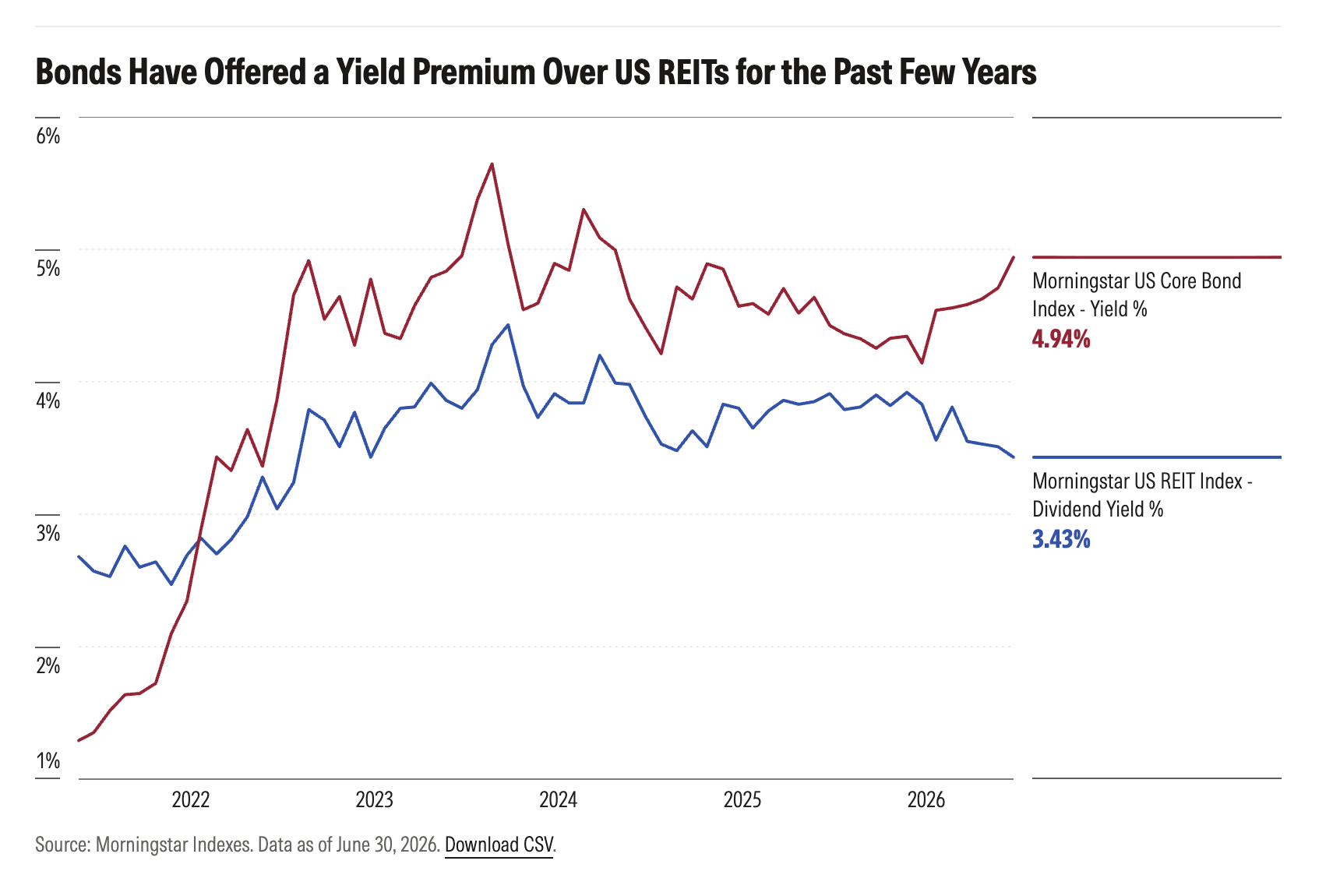
In early 2026, rates were actually a contributor to REIT returns, according to Brown. Before the Iran war started at the end of February, the yield on the 10-year US Treasury bond, which is closely linked to mortgage rates, came down. This contributed to significant February outperformance for the Morningstar US REIT Index. Although rising bond yields made life more difficult for REITs in subsequent months, the asset class has managed to maintain its performance edge.
What’s the Outlook for REITs?
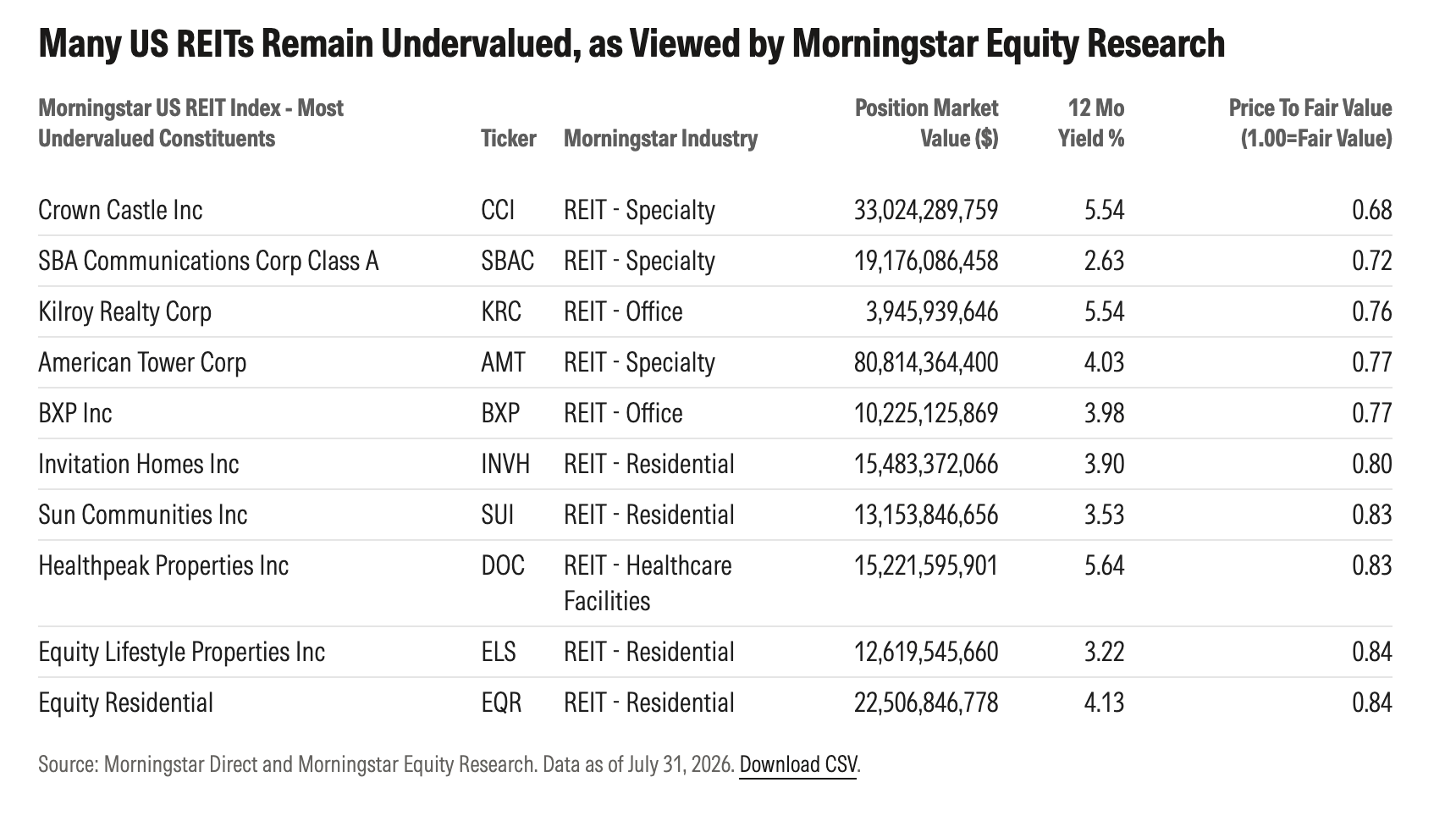
Even after their runup, many REITs offer potential upside in the eyes of Morningstar equity analysts. Twenty-six constituents of the Morningstar US REIT Index are under analyst coverage, representing roughly 70% of market value. Some of the largest REITs in the market, including Welltower and Simon Property Group, are considered richly valued after their 2026 runups.
But of the 26 covered REITs, 18 were trading below Morningstar equity analyst estimates of intrinsic value as of the end of July. The list of 10 most undervalued REITs includes some that yield north of 5%.
Rates remain a key, but difficult-to-forecast, factor in the REIT outlook. Inflation is running above the US Federal Reserve’s 2% target, thanks in part to higher energy costs from the Iran war. The direction of that conflict is obviously uncertain. The market, for its part, is expecting rate hikes in 2026’s second half. Beyond that, Morningstar forecasts rate cuts in 2027 and 2028 on slowing growth.
While lower rates could eventually provide a catalyst, REITs have shown in 2026 that they can thrive regardless. In recent years, they have faced a range of challenges, including remote work, e-commerce, and home-sharing services. Tough times can improve operating efficiency. REITs may have emerged stronger from their challenging spell.
While the broad US real estate sector looks fairly valued, there are plenty of REITs out there that may have room to run.
Also published on Morningstar.com
©2026 Morningstar. All Rights Reserved. The information, data, analyses and opinions contained herein (1) include the proprietary information of Morningstar, (2) may not be copied or redistributed, (3) do not constitute investment advice offered by Morningstar, (4) are provided solely for informational purposes and therefore are not an offer to buy or sell a security, and (5) are not warranted to be correct, complete or accurate. Morningstar has not given its consent to be deemed an "expert" under the federal Securities Act of 1933. Except as otherwise required by law, Morningstar is not responsible for any trading decisions, damages or other losses resulting from, or related to, this information, data, analyses or opinions or their use. References to specific securities or other investment options should not be considered an offer (as defined by the Securities and Exchange Act) to purchase or sell that specific investment. Past performance does not guarantee future results. Before making any investment decision, consider if the investment is suitable for you by referencing your own financial position, investment objectives, and risk profile. Always consult with your financial advisor before investing.
Indexes are unmanaged and not available for direct investment.
Morningstar indexes are created and maintained by Morningstar, Inc. Morningstar® is a registered trademark of Morningstar, Inc.