

The Takeaway
 Mega-IPOs such as SpaceX, Anthropic, and OpenAI may initially have limited impact on the Morningstar Market Indexes owing to low public float. But they can materially affect market-cap segmentation and concentration over time as available float expands.
 Longer private ownership and higher IPO valuations would further shrink the market share captured by count-based small-cap public market indexes. Companies ranked 1,001–3,000 represented just 3% of the market in 2025, down from 10% in the 1980s; their share would fall another 700bps if the largest unicorns went public.
 Looking beyond the largest unicorns, the broader private company ecosystem suggests that future IPO activity could ultimately reduce overall public market concentration.
Mega-IPOs such as Anthropic, OpenAI, and SpaceX show how the rise of private markets is reshaping public equity markets. Because companies now stay private longer and list at larger valuations, more public market value enters at the top of the capitalization spectrum, which raises concentration and shifts the makeup of market-cap segments. As Exhibit A shows, if seven leading private companies (Anthropic, OpenAI, Databricks, Stripe, Blue Origin, Waymo, and Figure) went public, the breakpoint between large and small caps would rise by almost 10%, and eight fewer top-ranked companies would be needed to reach 85% of the market. Both measures show how private companies are changing concentration at the top of the market.
Exhibit A: Impact of Private Companies Going Public on Breakpoints
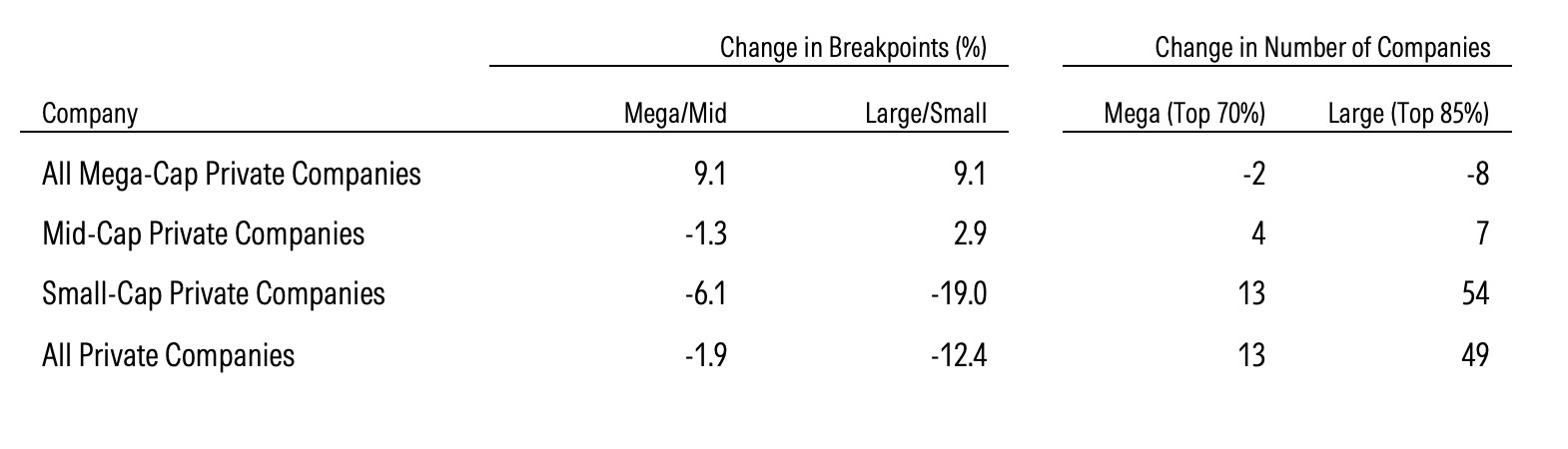
Source: PitchBook data as of Oct. 9, 2026; Morningstar Market Indexes data as of Sept. 4, 2026; Anthropic valuation is based on the form S-1 filed on Nov. 10, 2026, and assumes the mid-point valuation of $74.
Our analysis shows that index methodology plays a critical role in determining how investors experience these changes. A market-cap segmentation approach based on target market coverage adjusts to shifts in concentration and maintains a consistent representation of the investable opportunity set. Fixed-count approaches, by contrast, represent a declining share of the market as concentration rises, leading to materially different portfolio exposures over time. As Exhibit B shows, companies ranked 1,001–3,000 made up roughly 10% of the market in the 1980s but only about 3% in 2025, a third of their earlier share. If the top 7 mega-cap private companies were all listed publicly at 100% float, the market share of companies ranked 1,001–3,000 would fall by about additional 7%.
Exhibit B: A Fixed-Count Index Would Represent a Different Proportion of the Market due to Changes in listings and Concentration
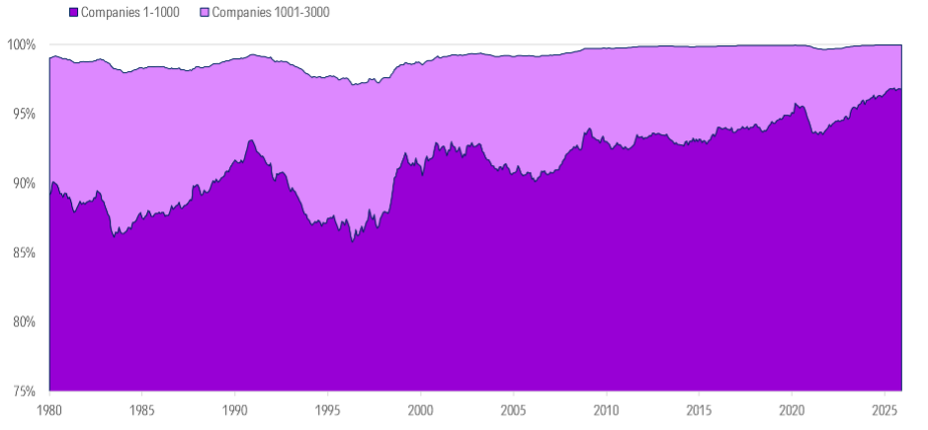
Source: CRSP RDP data from Morningstar; data as of Dec. 31, 2025. US-listed companies are equity securities excluding ADRs, REITs, and Units in the CRSP US Stock Database. Analysis excludes companies without market capitalization on the measurement date. Percentages equal the market cap of companies ranked from 1 to 1,000 or 1,001 to 3,000 divided by the total universe market cap, calculated from companies with available daily data.
The implications extend beyond any single IPO. If future public listings continue to occur at increasingly larger valuations, concentration at the top of the market is likely to remain elevated and the differences between index methodologies will become more pronounced. As a result, investors should consider not only market concentration itself, but also how index construction determines the way that concentration is reflected in their portfolios
©2026 Morningstar. All Rights Reserved. The information, data, analyses and opinions contained herein (1) include the proprietary information of Morningstar, (2) may not be copied or redistributed, (3) do not constitute investment advice offered by Morningstar, (4) are provided solely for informational purposes and therefore are not an offer to buy or sell a security, and (5) are not warranted to be correct, complete or accurate. Morningstar has not given its consent to be deemed an "expert" under the federal Securities Act of 1933. Except as otherwise required by law, Morningstar is not responsible for any trading decisions, damages or other losses resulting from, or related to, this information, data, analyses or opinions or their use. References to specific securities or other investment options should not be considered an offer (as defined by the Securities and Exchange Act) to purchase or sell that specific investment. Past performance does not guarantee future results. Before making any investment decision, consider if the investment is suitable for you by referencing your own financial position, investment objectives, and risk profile. Always consult with your financial advisor before investing.
Indexes are unmanaged and not available for direct investment.
Morningstar indexes are created and maintained by Morningstar, Inc. Morningstar® is a registered trademark of Morningstar, Inc.