

“Expect a volatile 2026,” wrote Morningstar’s Chief US Market Strategist Dave Sekera at the start of the year. Sekera cited a number of risk factors that could cause stock market volatility, including Federal Reserve leadership change, trade negotiations, inflation surprises, and geopolitical uncertainty.
Most of Sekera’s volatility drivers, and a few more, have already surfaced in early 2026. Although the announcement of Kevin Warsh as nominee for the next chair of the US Federal Reserve was not a major stock market mover, tariff threats tied to President Donald Trump’s ambitions to acquire Greenland caused a selloff in late January, while geopolitics and inflation fears manifested after the Iran war sent energy prices soaring. Artificial intelligence disruption has been another key 2026 volatility source.
Here’s how the US stock market fluctuations have looked so far this year. The CRSP US Total Market Index has seen several significant daily moves, including one of nearly 3%.
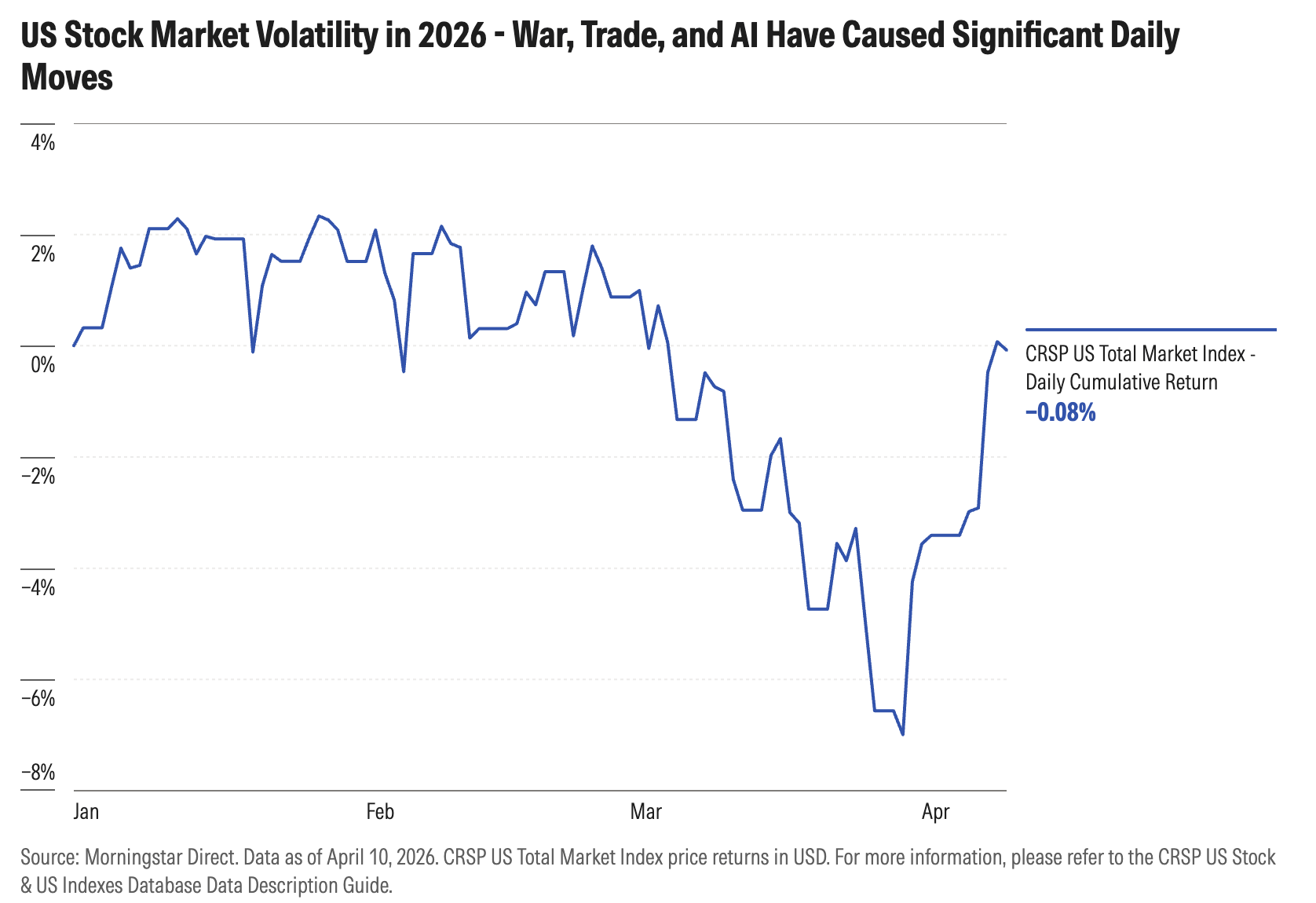
Expressed in standard deviation of daily returns, or how much the index’s fluctuations vary from their average, volatility for 2026 through April 10 registered at 15% on an annualized basis. How does that level of volatility compare historically for US stocks? What would it take for 2026 to be a volatile year by this measurement? And what does volatility mean for investors? To put 2026’s volatility into context, I looked at 100 years of US equity market data from the Center for Research in Security Prices (CRSP) with my colleague Aditya Pillai, a quantitative researcher on Morningstar Indexes.
What’s Typical for Stock Market Volatility?
It turns out that 15% is right about average for US stock market volatility. For all the press about volatility in 2026, things were much worse at this point last year. In fact, in mid-April 2025, I wrote a column about stock market volatility that included some tortured metaphors to March Madness. As you likely remember, tariff turmoil roiled markets in early 2025. The tariff announcement on April 2 triggered two daily losses of more than 5%, then a tariff pause caused a gain of 9.5% on April 9, 2025. From Jan. 1 through April 11, 2025, the CRSP US Total Market Index’s standard deviation of daily returns was 29.56% (annualized).
Over the past 100 years, the average annual standard deviation of daily US stock market returns comes in at 14.92%, according to Pillai (The CRSP US Total Market Index’s live history starts in 2011, but CRSP’s market-capitalization-weighted portfolio of all stocks listed on major US exchanges goes back to 1926. The index and the portfolio are similar enough to compare for this exercise.)
Averages, of course, mask extremes. Check out peaks and valleys in stock market volatility since 1926.
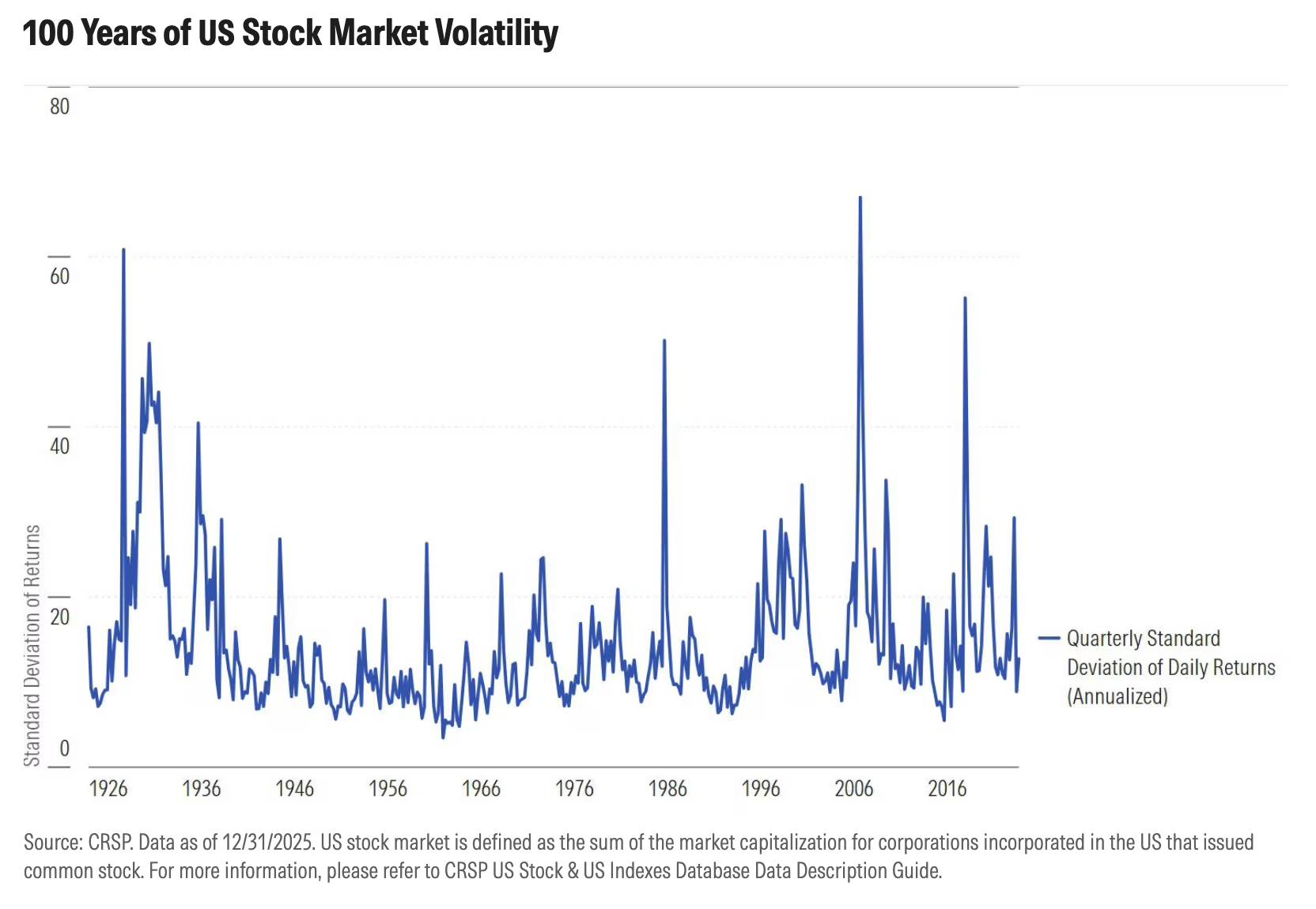
The most volatile periods for the US stock market occurred during the 2007-09 global financial crisis, followed by the market crash of 1929 that led to the Great Depression. Then comes the onset of the covid-19 pandemic volatility in early 2020, followed by the 1987 “Black Monday” crash, then the 1930s Depression bumps. All of these periods were associated with heavy losses for stocks. In the case of the global financial crisis and the Great Depression, the losses lasted a while. In 2020 and 1987, losses were short-lived. Stocks were up in both those years.
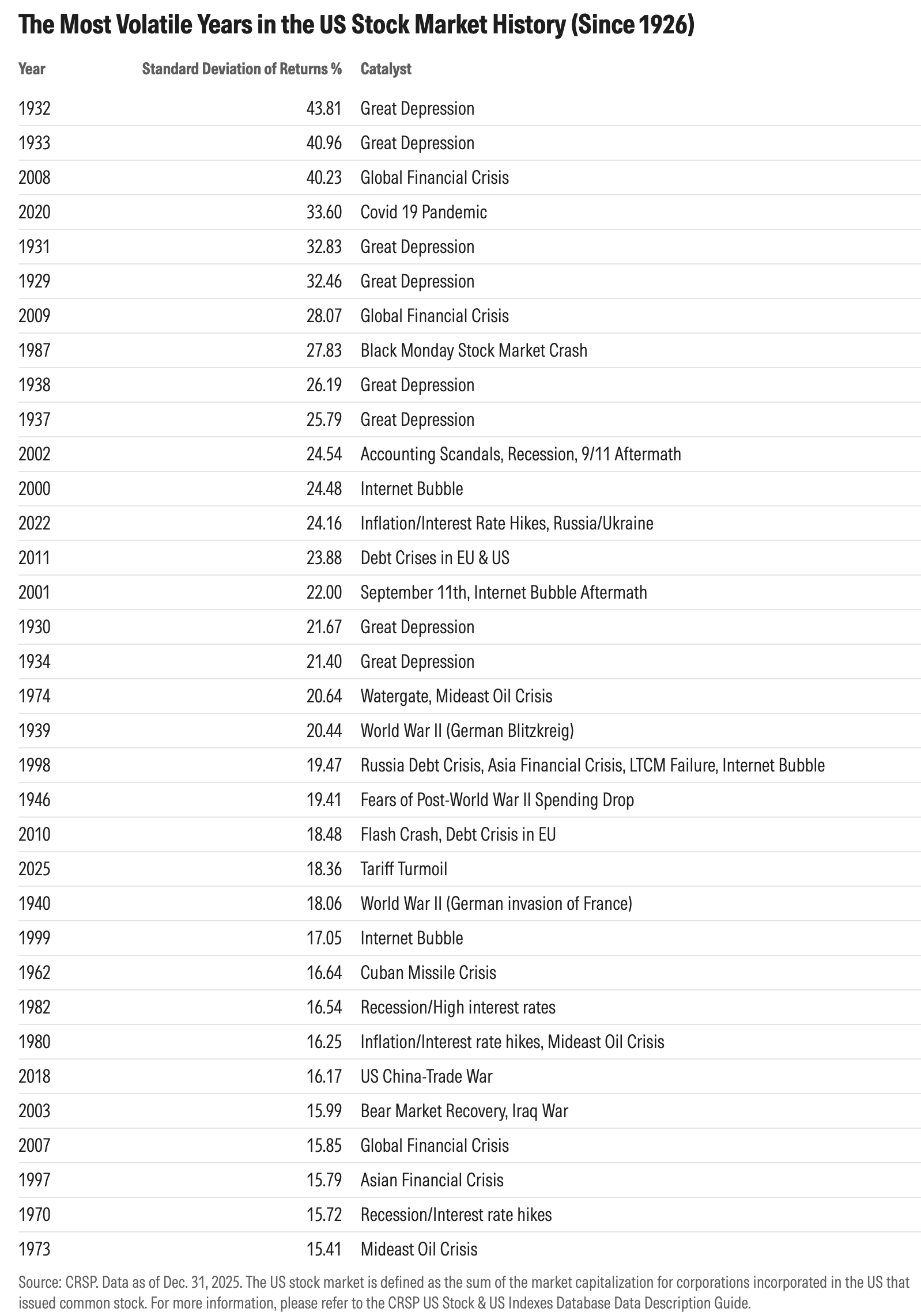
When it comes to calendar years, here are the 34 above-average years for US stock market volatility, ranked in order of volatility. All exceeded the 15% threshold in terms of standard deviation of daily returns. The other 66 years since 1926 registered a standard deviation of returns below 15%.
Do Geopolitics Drive Stock Market Volatility?
I mentioned the Iran war as a catalyst for volatility in 2026. Many of the geopolitical events highlighted in this investment chart, powered by CRSP’s historical data, contributed to stock market volatility. You’ll see volatile years associated with World War II, the Cuban Missile Crisis, Watergate, the September 11th, 2001, attacks, the Iraq War, tariffs, and several Middle East-related oil shocks.
But not every geopolitical event has resulted in extreme volatility. Think about what’s not included above. The years of active US participation in World War II, 1941-45, don’t feature. The wars in Korea and Vietnam were not especially volatile, nor was the first Gulf War (1990-91). Often, there’s volatility in anticipation or at the onset of an event, but then the market settles down.
In an analysis of past conflicts’ impact on stock market performance, my colleague Amy Arnott wrote:
[M]arket returns have often been positive in the one-year period following the outbreak of geopolitical trauma. That was the case after the start of the Iraq War in 2003, as well as many other conflicts, including World War I, World War II, Pearl Harbor, and Korea. (The war in Vietnam was a notable exception.)
What Does Stock Market Volatility Mean for Investors?
Savvy investment professionals are fond of saying that volatility is a feature, not a bug, of financial markets. That’s especially true for risk assets like stocks. Volatility shouldn’t be equated with risk, according to some. Actual risk, the saying goes, is the permanent impairment of capital.
True, but volatility can induce bad investor behavior. According to Morningstar’s “Mind the Gap” study, investors are more prone to buy high and sell volatile funds at the wrong times. The market’s best and worst days tend to cluster, according to research by my colleague Jeff Ptak. When investors react to volatility by exiting the market, they can miss out on rebounds.
Christine Benz, Morningstar’s director of personal finance and retirement planning, calls responding to volatility by retreating to cash “the classic volatile markets mistake.” She also acknowledges that investors in different life stages can see extreme fluctuations differently. Of young investors:
I would say the best thing to do at that life stage is to try to tune out the day-to-day market action and set yourself up for success by putting your contributions on autopilot, being in a reasonably equity-heavy portfolio, maybe mostly equity-heavy for retirement, and just letting those contributions do the work.
Things get trickier, of course, for older investors. “Sequence of returns” risk is a challenge for investors in or near retirement. Losses in an investment portfolio are harder to recover from at this stage, so stock market volatility can be particularly unnerving. That’s why it’s so important to have sufficient ballast in one’s portfolio at this stage. Bonds have historically helped investors weather the fluctuations inherent to equity investing.
How have you been handling stock market volatility? Have you made any portfolio adjustments, or are you just riding it out? Email me at dan.lefkovitz@morningstar.com if you’d like to share.
©2026 Morningstar. All Rights Reserved. The information, data, analyses and opinions contained herein (1) include the proprietary information of Morningstar, (2) may not be copied or redistributed, (3) do not constitute investment advice offered by Morningstar, (4) are provided solely for informational purposes and therefore are not an offer to buy or sell a security, and (5) are not warranted to be correct, complete or accurate. Morningstar has not given its consent to be deemed an "expert" under the federal Securities Act of 1933. Except as otherwise required by law, Morningstar is not responsible for any trading decisions, damages or other losses resulting from, or related to, this information, data, analyses or opinions or their use. References to specific securities or other investment options should not be considered an offer (as defined by the Securities and Exchange Act) to purchase or sell that specific investment. Past performance does not guarantee future results. Before making any investment decision, consider if the investment is suitable for you by referencing your own financial position, investment objectives, and risk profile. Always consult with your financial advisor before investing.
Indexes are unmanaged and not available for direct investment.
Morningstar indexes are created and maintained by Morningstar, Inc. Morningstar® is a registered trademark of Morningstar, Inc.