

Investors like dividend stocks, especially during tricky market conditions. That’s my reaction looking at five years of global asset flows data for dividend exchange-traded funds. In the first quarter of 2026, dividend ETFs—some focused on high-yielders, others on dividend-growers—attracted nearly $22 billion on a net basis, the most since the second quarter of 2022.
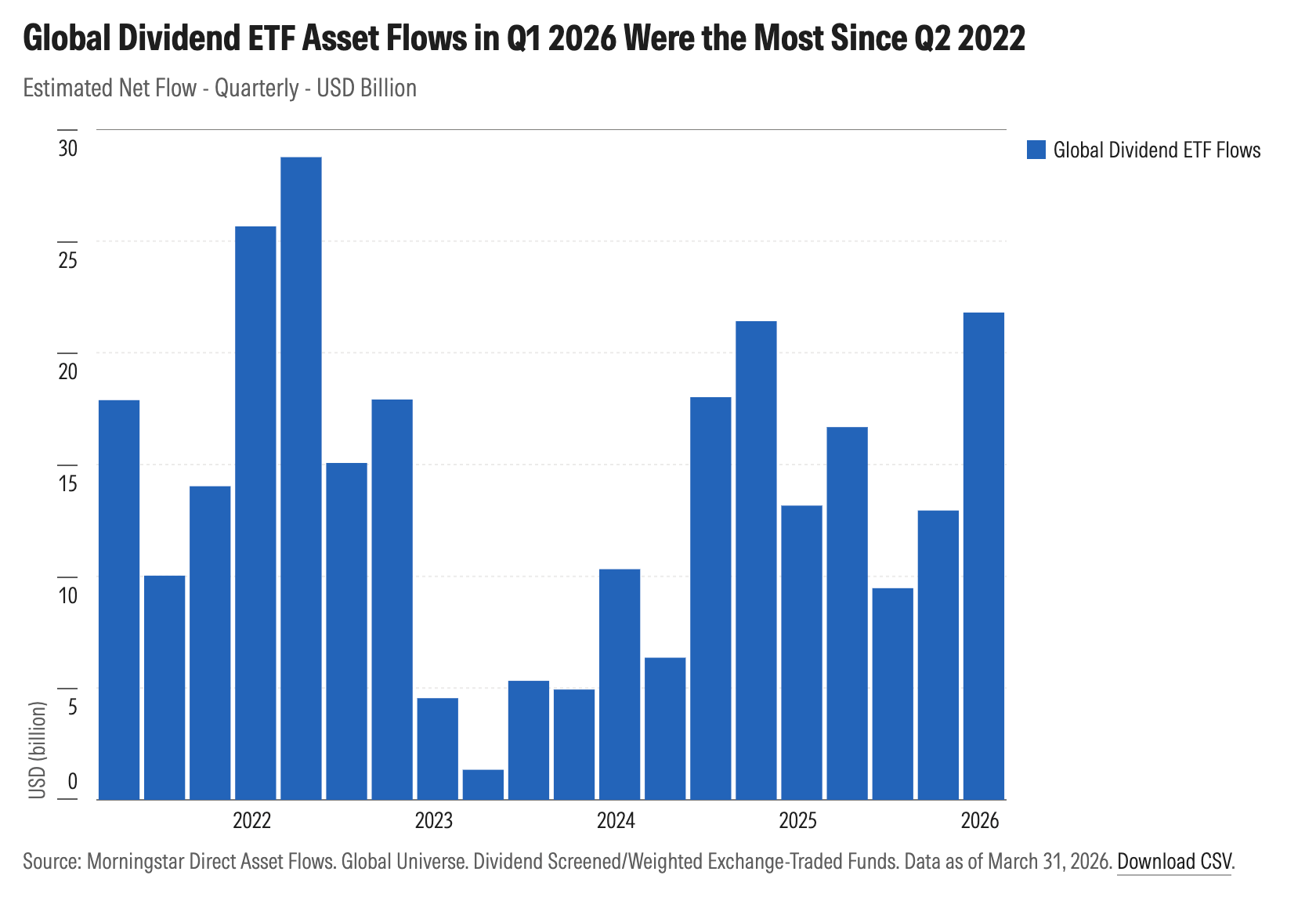
Interest in dividend stocks seems less about income and more about playing defense in equities. There’s nothing inherently wrong with that. But recent years have shown that investors haven’t done a great job of timing their dividend stock allocations.
When Fixed Income Exceeds Dividend Income
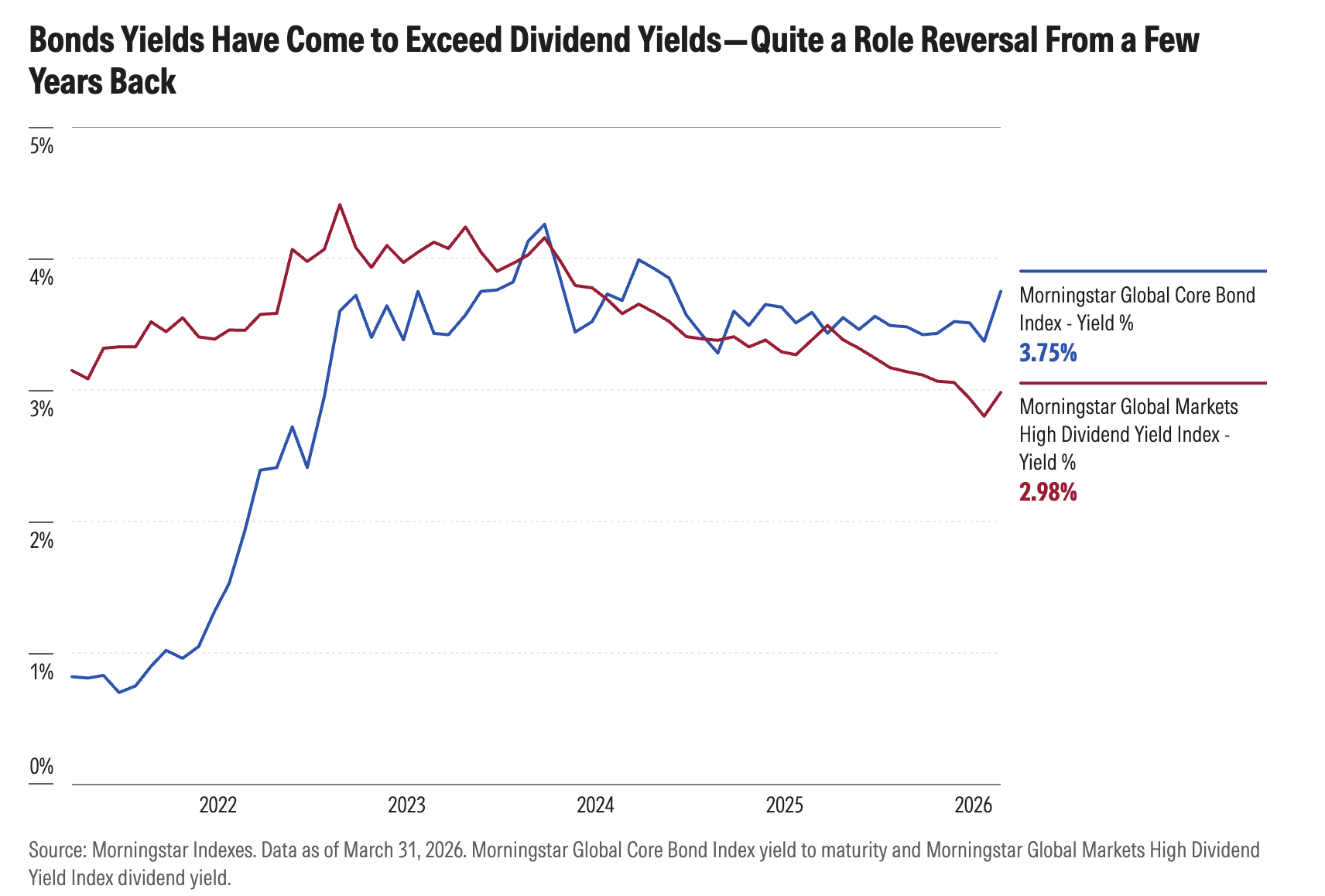
Dividend income is attractive to many investors, but in recent years, bond yields have surpassed dividend yields. It’s quite a reversal from 2021, before global central banks jacked up interest rates to combat inflation. Although 2025 brought some rate cuts, borrowing costs remain elevated. Inflation continues to run hot.
Meanwhile, dividend yields have faced downward pressure. Equity prices have generally marched higher since 2023. In the US, cash payments to shareholders have taken a back seat to share repurchases and investments in artificial intelligence.
As a result, yields on core fixed-income allocations exceed those on dividend stocks. The Morningstar US Core Bond Index yielded 4.5% as of March 31, 2026, compared with just 2.3% for the Morningstar US High Dividend Yield Index. The gap is narrower outside the US, but a gap remains.
Dividend Stocks Wearing HALOs
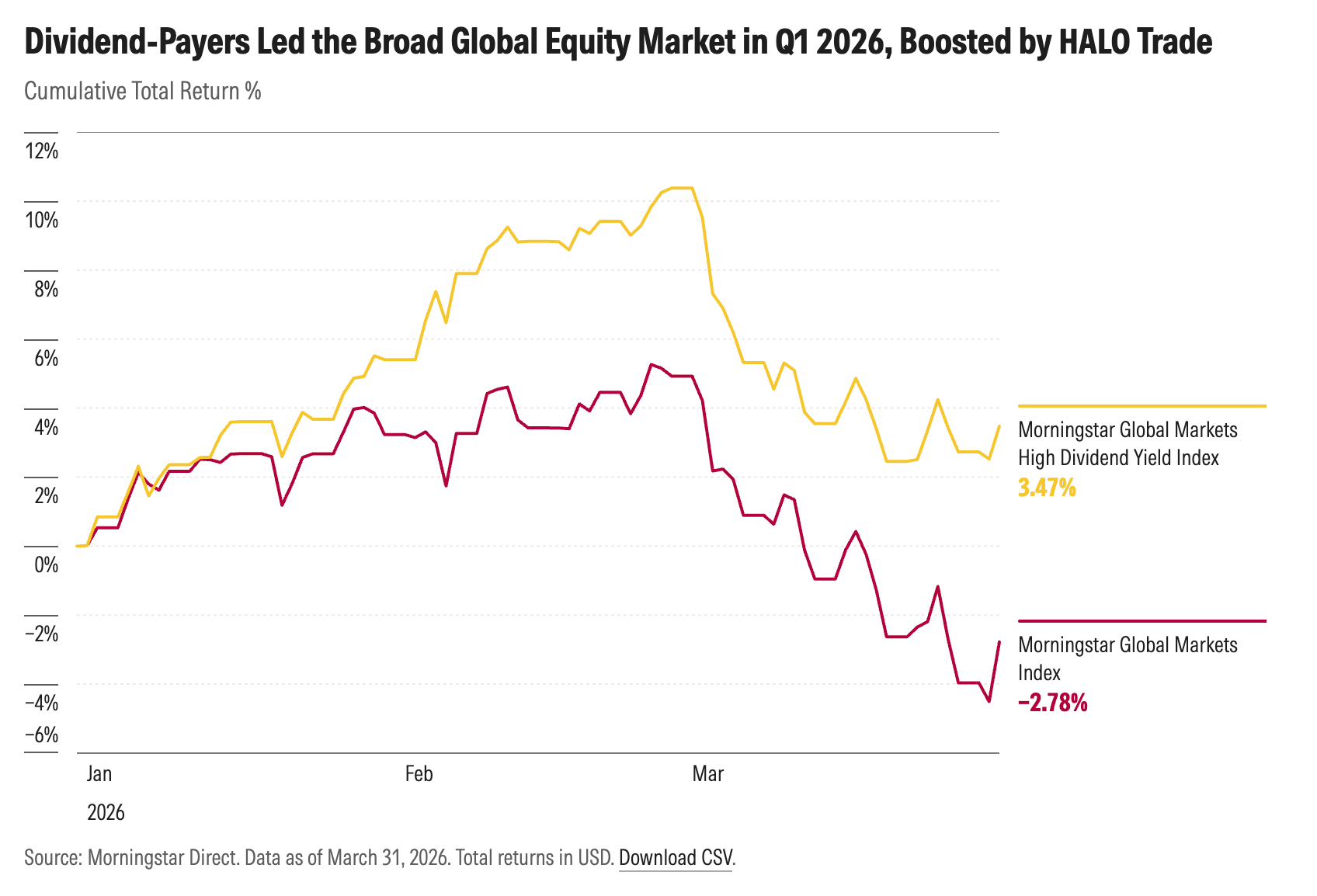
If it’s not income attracting flows into dividend ETFs, tricky equity market conditions seem the stronger pull. The first quarter of 2026 saw a shift in investor sentiment from AI enthusiasm to fear over AI-disrupting business models. Software-related industries, especially, sold off sharply.
In March, I wrote about how the HALO trade was boosting dividend stock performance. The shares of companies characterized by Heavy Assets, Low Obsolescence led the market in early 2026. Dividend-rich sectors like utilities, basic materials, industrials, and consumer defensives were in favor. Meanwhile, the Iran war boosted oil prices, which helped the high-yielding energy sector.
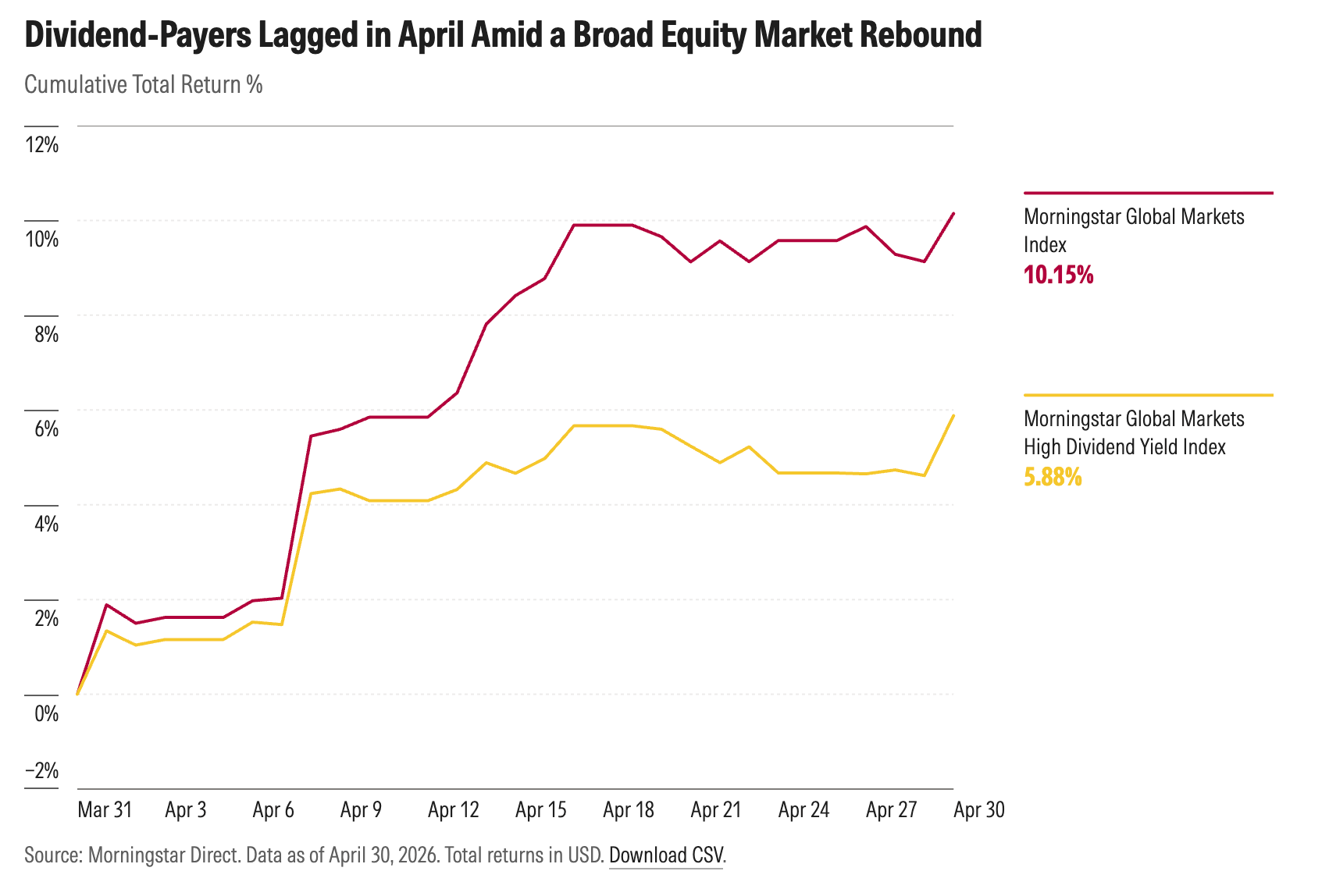
Inflows to dividend ETFs came just in time for dividend stocks to lag amid a rebound in the broad equity market. In April, investor sentiment turned bullish, having looked past the Middle East conflict, refocusing on AI and strong corporate fundamentals. Technology stocks bounced back strongly.
Risk-Averse Investors Have Turned to Dividend Stocks Before
This is not the first time investors have piled into dividend stocks during a period of outperformance. In 2022, sharp interest rate hikes sparked a huge selloff in equities. Technology stocks fell furthest, while dividend-rich sectors like healthcare, consumer staples, and energy held up best, with Russia’s invasion of Ukraine having boosted energy prices. More than $50 billion in investor capital flowed into dividend ETFs in the first half of 2022.
That money came in just in time for dividend stocks to lag in 2023 and 2024. As a reminder, the launch of ChatGPT in late 2022 sparked an AI-enthused bull market that left dividend stocks looking sluggish. Net flows to dividend ETFs slowed considerably on a global basis. In the US, they even turned negative in 2023 and early 2024.
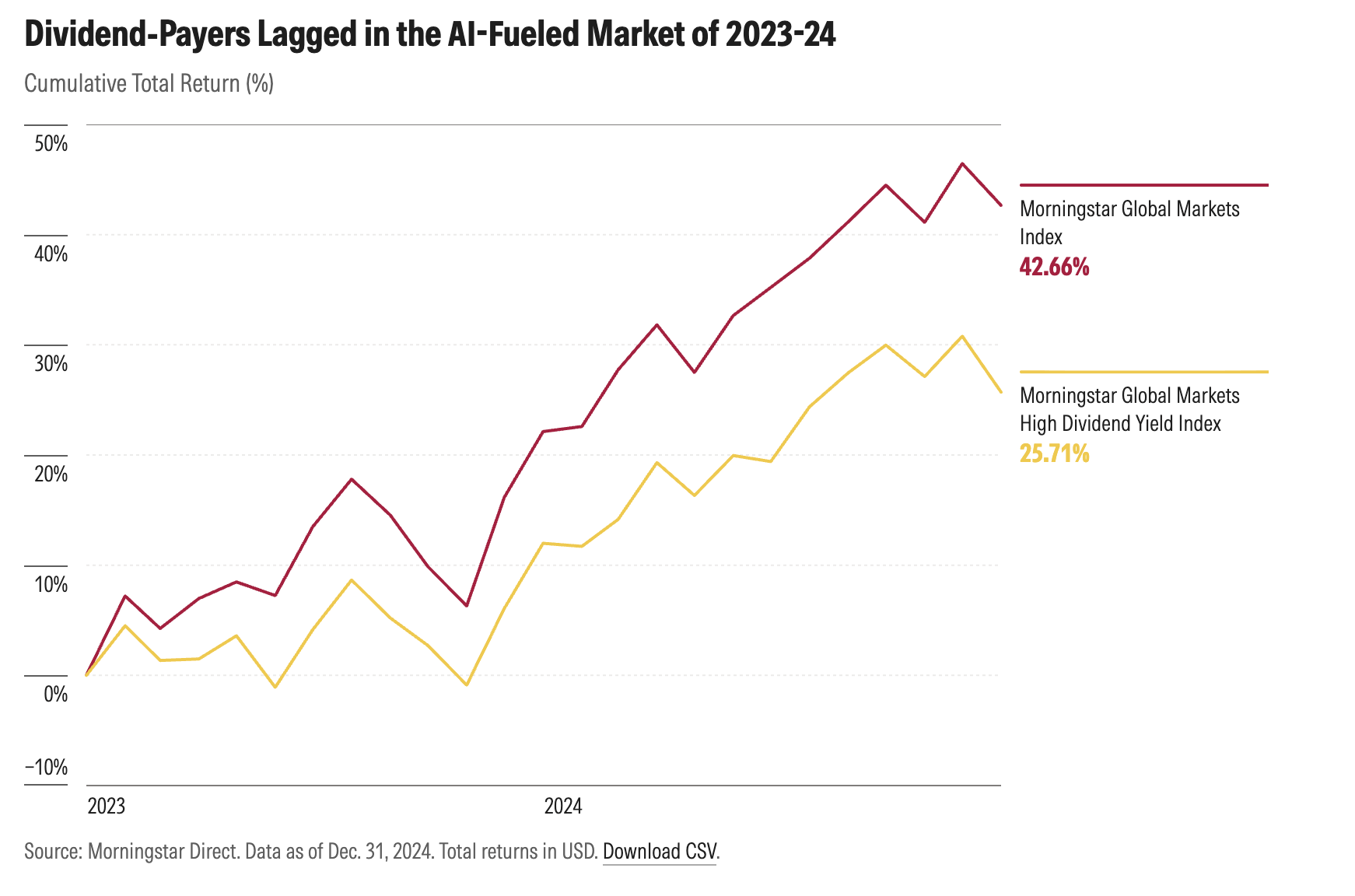
But the third quarter of 2024 renewed interest in dividends. An unexpected rate hike in Japan and concerns over the US economy, interest rates, earnings, and valuations all contributed to equity market volatility. Flows to dividend ETFs picked up in late 2024 and continued into 2025, when President Donald Trump’s tariff agenda spooked investors and defensive areas of the stock market held up best.
Even after markets settled down in mid-2025 and the technology sector rebounded, dividend-payers posted solid returns. The utilities sector was a real standout last year, benefiting from rising power demand from AI. Outside the US, financials, another dividend-rich sector, performed exceedingly well.
Dividends for the Long Term
Only time will tell if the technology-led equity market rebound of April 2026 endures. If it does, flows to dividend ETFs could reverse. Over the past five years, investor interest in dividend stocks has tracked their relative performance.
Clearly, for many investors, dividend stocks are less about the income they generate and more about the defensive traits they possess. That’s fine. As a group, dividend-paying companies tend to be more established, stable, and lower priced than nonpayers.
But it’s best to be invested in dividend stocks before you need defense, not after. Like any deviation from the broad market, a portfolio of dividend stocks will go through periods of both outperformance and underperformance. Rather than trying to time rotations, investors are best served holding dividend stocks for the long term.
©2026 Morningstar. All Rights Reserved. The information, data, analyses and opinions contained herein (1) include the proprietary information of Morningstar, (2) may not be copied or redistributed, (3) do not constitute investment advice offered by Morningstar, (4) are provided solely for informational purposes and therefore are not an offer to buy or sell a security, and (5) are not warranted to be correct, complete or accurate. Morningstar has not given its consent to be deemed an "expert" under the federal Securities Act of 1933. Except as otherwise required by law, Morningstar is not responsible for any trading decisions, damages or other losses resulting from, or related to, this information, data, analyses or opinions or their use. References to specific securities or other investment options should not be considered an offer (as defined by the Securities and Exchange Act) to purchase or sell that specific investment. Past performance does not guarantee future results. Before making any investment decision, consider if the investment is suitable for you by referencing your own financial position, investment objectives, and risk profile. Always consult with your financial advisor before investing.
Indexes are unmanaged and not available for direct investment.
Morningstar indexes are created and maintained by Morningstar, Inc. Morningstar® is a registered trademark of Morningstar, Inc.